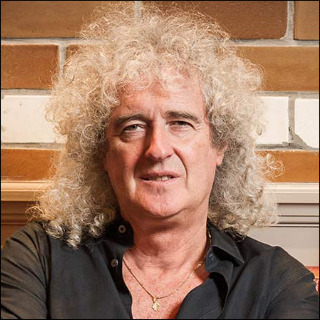
Sir Brian Harold May is an English musician, songwriter, and astrophysicist who achieved global fame as the legendary lead guitarist and a principal songwriter for the rock band Queen. His distinctive guitar sound, crafted on his homemade Red Special guitar, and his anthemic compositions like "We Will Rock You" and "Who Wants to Live Forever" were integral to Queen's status as one of the most successful and innovative acts in music history. Beyond rock stardom, May has also forged a distinguished parallel career in science, earning a PhD in astrophysics and contributing to NASA missions, while his advocacy for animal welfare has marked him as a prominent activist.
Born in Hampton, London, in 1947, Brian May developed an early passion for both music and astronomy. He built his iconic Red Special guitar with his father in the early 1960s, an instrument that would define his sound. While studying physics at Imperial College London, he formed the band Smile with drummer Roger Taylor. In 1970, after Smile's singer departed, May and Taylor were joined by flamboyant frontman Freddie Mercury and later bassist John Deacon to form Queen. The band's blend of hard rock, opera, and theatricality culminated in the monumental 1975 album A Night at the Opera and its groundbreaking single "Bohemian Rhapsody," propelling them to international superstardom.
Throughout Queen's reign, May was the architect of some of their most enduring hits, including "We Will Rock You," "Fat Bottomed Girls," "I Want It All," "Hammer to Fall," and "The Show Must Go On." His layered guitar orchestrations and virtuosic solos became a trademark of the band's sound. Queen's legendary performance at the 1985 Live Aid concert, where May's guitar echoed around Wembley Stadium, is often cited as one of the greatest live sets ever. Following Mercury's death in 1991, Queen entered a hiatus, though May and Taylor performed at the 1992 tribute concert and later reconvened the band for projects with vocalists including Paul Rodgers and Adam Lambert.
Alongside his music career, May pursued his academic interests, completing his PhD in astrophysics in 2007. He has served as a science team collaborator on NASA's New Horizons mission to Pluto and the OSIRIS-REx asteroid sample return mission. Asteroid 52665 Brianmay is named in his honor. A committed animal welfare activist, he campaigns against fox hunting and badger culling. His services to music and charity were recognized with a CBE in 2005 and a knighthood in the 2023 New Year Honours. Inducted into the Rock and Roll Hall of Fame with Queen in 2001, Sir Brian May remains a unique figure, seamlessly bridging the worlds of rock legend, scientific inquiry, and humanitarian effort.