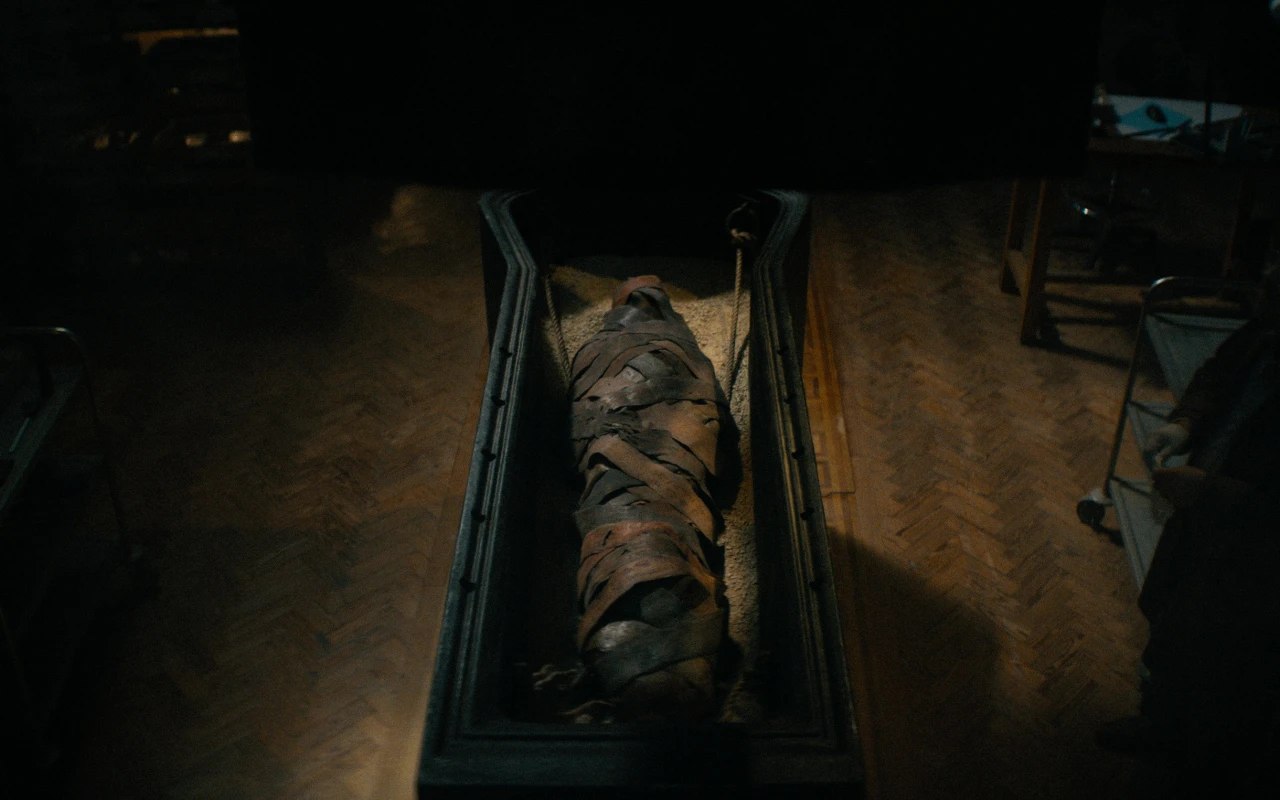
A family is haunted by their catatonic daughter in Lee Cronin's visceral horror, fusing ancient evil with demonic dread and relentless gore.
- April 17, 2026
AceShowbiz - Lee Cronin's The Mummy marks a fierce plunge into a visceral family horror that combines ancient evil with relentless gore. Directed by Irish filmmaker Lee Cronin, known for exploiting parental fears in previous works like The Hole in the Ground and Evil Dead Rise, this film doubles down on that theme with a wild, disturbing narrative about a family haunted by their violently catatonic daughter. The movie’s tone fuses the demonic dread of The Exorcist with the psychological torment of Hereditary, creating an unsettling and kinetic horror experience.
The film opens with a gripping prologue set on the outskirts of Cairo, where a family’s normal life is shattered by a mysterious and malevolent force. The mother, who identifies herself as "a magician," grows increasingly irritated by her lively children, and the discovery of their pet canary drowned in blood sets the stage for the sinister presence linked to an ancient basalt sarcophagus buried beneath their home. This artifact holds a dark power, tethering the family to a dreadful secret and the need to contain a malevolent spirit.
The plot shifts to focus on eight-year-old American Katie Cannon (played as a child by Emily Mitchell), who forms a secret bond with the magician, and soon after disappears without a trace. Katie’s father, Charlie (portrayed by Jack Reynor), is a TV news correspondent devastated by her disappearance. Despite police investigations led by junior detective Dalia Zaki (played by May Calamawy), no clues surface, and the family’s life unravels.
Fast-forward eight years, the Cannon family has relocated from Egypt to Albuquerque, New Mexico. Katie’s mother, Larissa (played by Laia Costa), her younger brother Sebastian (Shylo Molina), and younger sister Maud (Billie Roy)—who was unborn at Katie’s disappearance—live with Larissa’s Mexican American mother, Carmen (Veronica Falcón). The family’s fragile hope is reignited when Egyptian authorities inform them that Katie has been found alive.
Upon her return, Katie (now portrayed by Natalie Grace) is a terrifying figure—wrapped in ancient bandages inscribed with centuries-old Hieratic script, her pale, withered skin and contorted body movements radiate an unholy presence. Though she is alive physically, her behavior is erratic, violent, and otherworldly. Her unpredictable convulsions and animalistic sounds unsettle everyone around her, especially as she exhibits strength and precision in her aggressive actions, posing a concussion risk from headbutts alone.
The Cannons wheel their unresponsive daughter back to New Mexico, where the desert setting mirrors the eerie Egyptian farmhouse from the film’s beginning. The tension escalates when Larissa’s mother prays over Katie, inadvertently stirring a malevolent force within her. Larissa, a nurse armed with sedatives, refuses to send Katie to specialized care, determined to keep her at home despite the growing danger. Meanwhile, Maud's curiosity about the sister she never knew contrasts with Sebastian’s fearful distance.
The film pays homage to classic horror moments, such as the projectile vomiting reminiscent of Linda Blair’s Regan in The Exorcist, mixed with unnerving animalistic behaviors, levitation, and disturbing bodily contortions. Katie’s unsettling activities include crawling through the house’s walls and ingesting live creatures, like a scorpion, adding layers of grotesque horror. Charlie eventually suggests relocating Katie for her safety, but Larissa’s maternal instincts push back fiercely.
Research into the origins of the evil reveals the presence of a malevolent spirit, "the destroyer of family," once believed to be sealed away.
Detective Zaki’s investigation in Egypt uncovers critical evidence. The film’s horror escalates mercilessly, challenging viewers with graphic and repulsive imagery that tests the limits of shock tolerance.
Lee Cronin crafts a relentless crescendo of body horror and gore that sometimes sacrifices narrative clarity for spectacle. The story’s connective threads between major horror set pieces are thin, yet the director’s flair for visual intensity and pacing keeps the audience engaged.
The movie culminates in an intense, brutal climax within the family home, where ultimate parental sacrifice is demanded. The narrative then returns to Egypt for a coda that ties together the film’s disparate plotlines, providing a satisfying conclusion to the chaotic nightmare.
While the film’s length and over-the-top body horror excesses may overwhelm some viewers, Lee Cronin's The Mummy offers a fresh, lurid take on the mummy mythos, emphasizing unflinching horror and family tragedy over traditional adventure or romance. It stands out as a boldly crafted, nightmarish exploration of supernatural dread and parental fear, backed by a talented cast including Jack Reynor, Laia Costa, and Natalie Grace.
Rated R and running two hours and twenty minutes, Lee Cronin's The Mummy is a harrowing experience for fans of visceral supernatural thrillers.