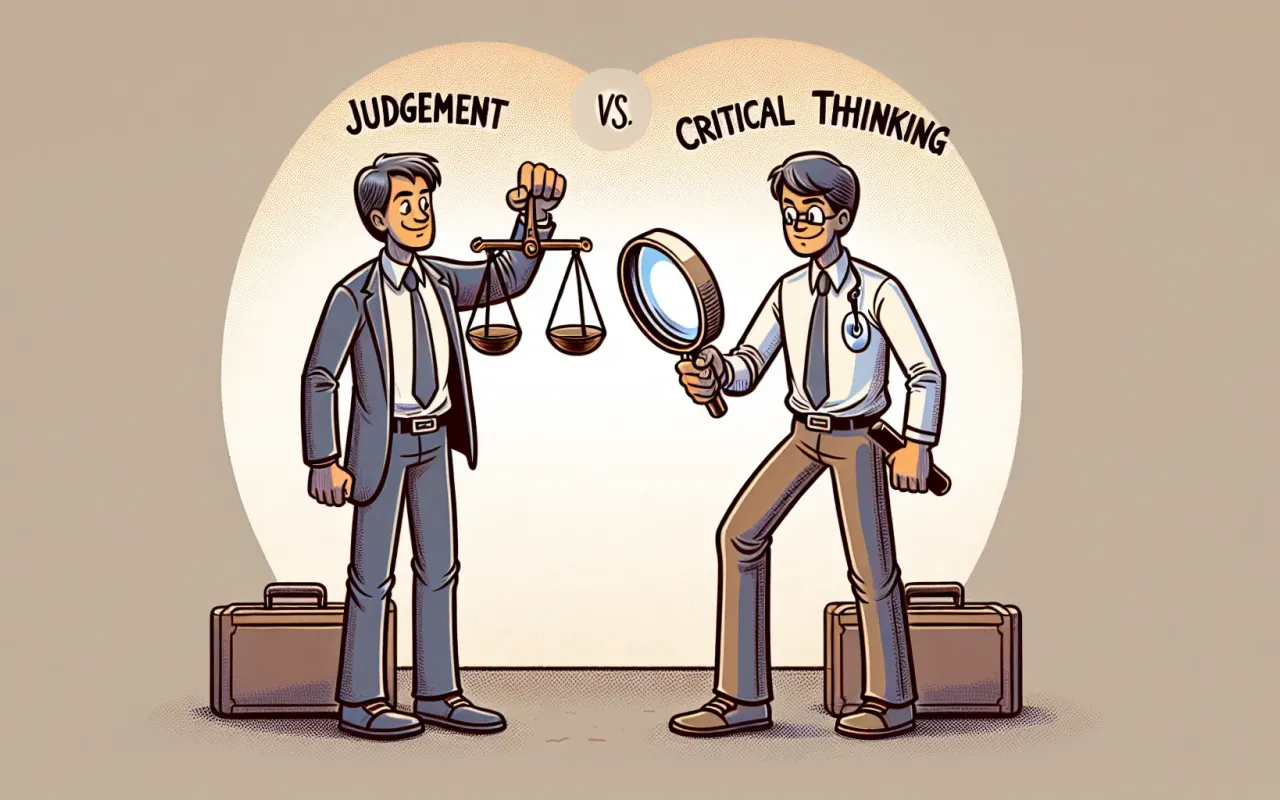
Explore the differences between judgment and critical thinking. Understand the importance of these concepts and how to improve them to make better decisions.
- August 10, 2024
In the realm of decision-making, the terms judgment and critical thinking are often used interchangeably. However, they refer to distinct cognitive processes that play crucial roles in how we analyze information and make choices. This article aims to elucidate the key differences between judgment and critical thinking, offering practical insights on how to harness both to enhance decision-making skills.
What is Judgment?
Judgment is the cognitive process of forming an opinion or conclusion based on available information. It is often seen as an intuitive process that relies on past experiences, inherent biases, and personal beliefs. Judgment requires relatively quick processing and is typically employed in scenarios that demand immediate decision-making.
What is Critical Thinking?
Critical thinking is the systematic evaluation of information to form a reasoned judgment. It involves a detailed analysis of evidence, recognition of assumptions, and evaluation of arguments. Critical thinking is a more deliberate process and is characterized by skepticism, open-mindedness, and the consideration of multiple perspectives.
Judgment vs Critical Thinking: Key Differences
1. Speed of Processing
Judgment is often instantaneous and driven by gut feelings or intuition, while critical thinking is more time-intensive, requiring a detailed evaluation of information.
2. Basis of Decisions
Judgment relies heavily on personal experiences and biases, whereas critical thinking emphasizes evidence-based reasoning and objectivity.
3. Flexibility
Judgment can be rigid, influenced by preconceived notions and biases. In contrast, critical thinking is inherently flexible, always open to new evidence and differing viewpoints.
Why Are These Differences Important?
Understanding the distinction between judgment and critical thinking can significantly enhance our decision-making abilities. While judgment allows for quick and often necessary snap decisions, critical thinking enables us to make well-considered and rational choices.
How to Improve Judgment and Critical Thinking Skills
1. Reflection
Regularly reflect on past decisions to understand what influenced your judgment and the outcomes. This helps in recognizing biases and improving future judgments.
2. Practice Critical Thinking Exercises
Engage in activities that foster critical thinking, such as debates, solving puzzles, and analyzing case studies. These exercises can enhance your ability to evaluate information logically.
3. Seek Diverse Perspectives
Expose yourself to different viewpoints. This can help you broaden your understanding and minimize biases, enhancing both judgment and critical thinking skills.
4. Continuous Learning
Stay informed and updated on various topics. A broad knowledge base can improve your ability to make informed judgments and think critically.
When to Rely on Judgment vs Critical Thinking
Both judgment and critical thinking have their place:
- Judgment: Best used in situations requiring quick decisions, such as in emergencies or when time-sensitive actions are needed.
- Critical Thinking: Ideal for complex decisions that require thorough analysis and detailed evaluation, such as strategic planning or problem-solving.
Conclusion
In conclusion, both judgment and critical thinking are essential cognitive processes that serve different purposes in decision-making. By understanding the key differences between the two, individuals can better decide when to rely on quick, intuitive judgment and when to employ methodical, evidence-based critical thinking. Cultivating both sets of skills can lead to more effective and balanced decision-making, ultimately enhancing both personal and professional growth.
By investing in the development of both judgment and critical thinking, individuals gain the ability to navigate complex situations with greater accuracy, making decisions that are both timely and well-reasoned.