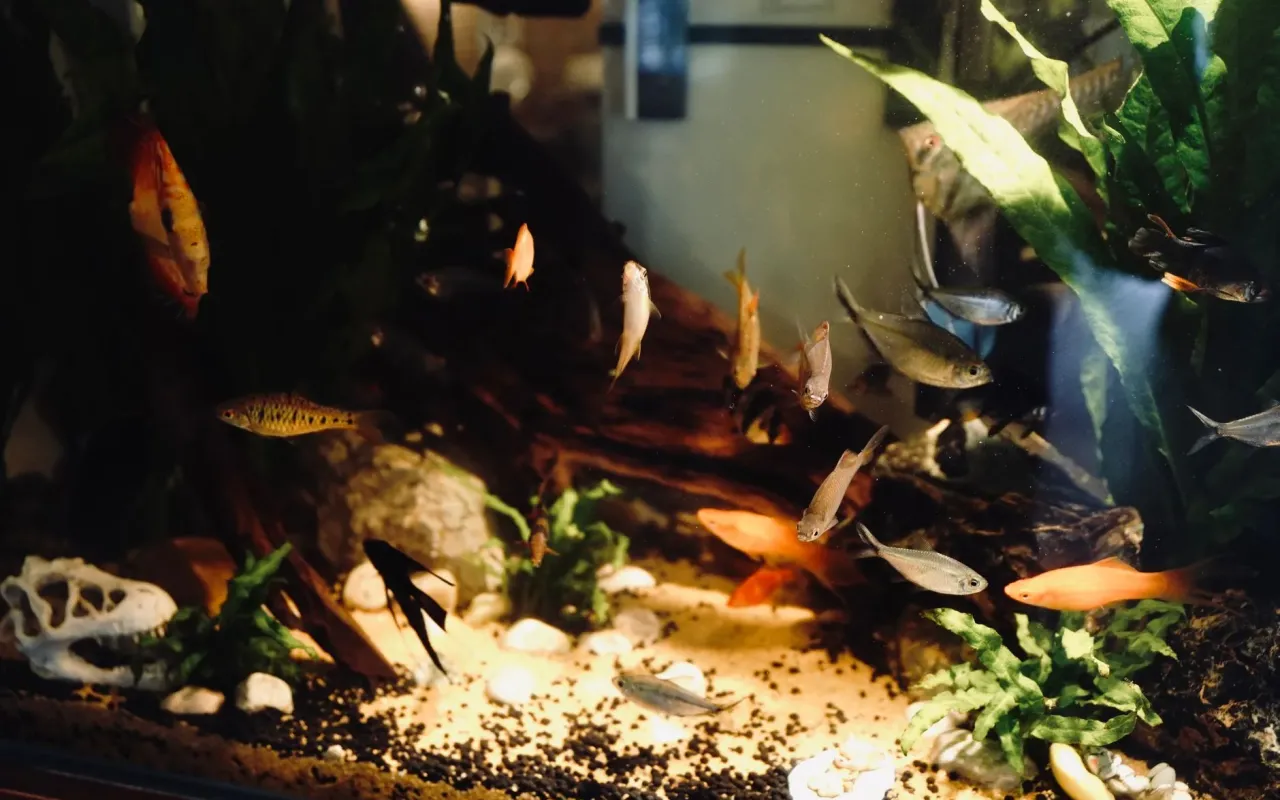
Stop guessing on tank size for your community fish. We break down the real gallon requirements, stocking rules, and why bigger is better for beginners.
- June 8, 2026
I Bought a 10-Gallon Tank for Community Fish—Here's Why I Regret It
When I first got into fishkeeping, I thought a 10-gallon tank would be perfect. It fit on my desk, looked clean, and the pet store employee said it was fine for "a few small community fish." Three months later, I was dealing with stressed tetras, a dead guppy, and water parameters that looked like a chemistry experiment gone wrong. I learned the hard way that tank size isn't just about aesthetics—it's the single most important factor for your fish's health and your sanity.
Community fish—species like neon tetras, corydoras catfish, and platies—are social by nature. They need space to swim, hide, and establish natural hierarchies. A tank that's too small doesn't just cramp their style; it causes chronic stress, weakens immune systems, and leads to aggression. The good news? You don't need a biology degree to pick the right size. You just need to know a few hard rules and why they matter.
Let's walk through the real numbers, the common mistakes, and the tank sizes that actually work for a thriving community tank. I'll share what I wish someone had told me before I wasted money on a setup that was doomed from the start.
The 1-Inch-Per-Gallon Rule Is a Lie (Here's What to Use Instead)
You've probably heard the old rule: one inch of fish per gallon of water. It sounds simple, but it's dangerously misleading. A 10-inch fish produces far more waste than ten 1-inch fish, and a tall, skinny tank has less surface area for oxygen exchange than a long, shallow one. This rule ignores fish shape, activity level, and bioload—the three things that actually determine how many fish your tank can support.
Instead, use the surface area rule: for community fish, aim for 12 square inches of water surface per inch of adult fish length. A standard 20-gallon long tank (30 inches by 12 inches) gives you 360 square inches, which comfortably supports about 30 inches of fish. That's roughly 15 neon tetras (each about 2 inches) or a mix of 10 tetras and 5 corydoras. This rule accounts for oxygen exchange, which is critical for fish health.
Another practical method is the 1 gallon per 1 inch of fish for the first 10 inches, then 2 gallons per inch after that. This scales better for larger fish. For example, a 6-inch angelfish needs 12 gallons on its own, not 6. Apply this to your whole community: if you want 20 inches of total fish length, a 30-gallon tank is safer than a 20-gallon. I now use this rule for every new tank setup, and my fish stay active and colorful instead of hiding in corners.
Why 20 Gallons Is the Minimum for Most Community Tanks
I know 10-gallon tanks are cheap and cute. I bought one. But after keeping fish for years, I can tell you that a 20-gallon tank is the real starting point for a happy community. Here's why: most popular community fish—like neon tetras, harlequin rasboras, and corydoras catfish—need to live in groups of at least six to feel secure. A 10-gallon tank can hold six neon tetras and maybe a small pleco, but that's it. You have zero room for error or variety.
A 20-gallon long tank (30 inches by 12 inches) gives you enough horizontal swimming space for active fish like danios and rasboras. It also allows you to add a cleanup crew—like a small school of corydoras (6-8 fish) and a single bristlenose pleco—without overcrowding. I've kept a community of 10 neon tetras, 6 corydoras, and 2 honey gouramis in a 20-gallon long for two years, and they've bred multiple times. That's a sign of a healthy, unstressed environment.
If you're on a budget, look for a used 20-gallon long on Facebook Marketplace or Craigslist. I got mine for $30 with a stand. The extra 10 gallons over a 10-gallon tank costs maybe $20-40 more upfront but saves you hundreds in future upgrades, dead fish replacements, and water treatment chemicals. It's the single best investment you can make as a beginner.
The Three Fish That Will Ruin Your Small Tank Plans
Some fish are sold as "community" but are actually ticking time bombs in small tanks. I've fallen for these, and I don't want you to make the same mistake. First, common plecos (the ones sold for $3 at pet stores) grow to 18-24 inches and produce massive waste. A 10-gallon tank with a common pleco is a death sentence for both the fish and your water quality. Stick to bristlenose plecos (4-5 inches max) or otocinclus catfish for small tanks.
Second, silver dollars look like peaceful, shiny coins—until they grow to 6 inches and need a 75-gallon tank. They're schooling fish that require a group of 5-6, and they're active swimmers. I once saw a customer buy six silver dollars for a 20-gallon tank, and within three months, they were stunted and aggressive. The store should have refused the sale, but they didn't. Do your research on adult sizes, not juvenile sizes.
Third, gouramis seem gentle, but many species (like blue gouramis) can reach 6 inches and become territorial in small spaces. I kept a pair of dwarf gouramis (2-3 inches) in a 20-gallon tank, and even they needed plenty of plants and hiding spots to avoid squabbles. A single honey gourami or sparkling gourami is fine for a 20-gallon, but anything larger needs 30 gallons minimum. Always check the adult size and temperament before buying.
How to Calculate Your Real Stocking Capacity (Without Math Anxiety)
You don't need a spreadsheet to figure out how many fish your tank can hold. But you do need to consider three factors: adult size, bioload, and swimming style. Let's break it down with a real example. Say you want a community of neon tetras (1.5 inches each), corydoras catfish (2 inches each), and a honey gourami (2.5 inches). For 10 tetras (15 inches), 6 corydoras (12 inches), and 1 gourami (2.5 inches), your total adult fish length is 29.5 inches.
Using the surface area rule: a 20-gallon long tank has 360 square inches. Divide by 12 (the rule's constant) gives you 30 inches of fish capacity. So this community fits perfectly—on paper. But you also need to account for bioload. Corydoras are bottom feeders that stir up waste, and tetras are mid-water swimmers. A 20-gallon long has enough floor space for corydoras to forage and enough horizontal space for tetras to school. This is a balanced community.
For a practical tool, use AqAdvisor (a free online stocking calculator). Enter your tank dimensions, filter type, and fish species. It gives you a stocking percentage and warns about aggression or overstocking. I run every potential community through it before buying fish. It's not perfect, but it's way better than guessing. One tip: keep your stocking level below 85% to leave room for error and growth. My 20-gallon long runs at 80%, and I've never had an ammonia spike.
The Filter and Maintenance Reality Check for Each Tank Size
A bigger tank isn't just about more water—it's about easier maintenance. A 10-gallon tank requires weekly water changes of 25-30% to keep nitrates low, and any mistake (like overfeeding) can crash the cycle within hours. I learned this when I added one extra tetra to my 10-gallon, and the ammonia hit 2 ppm the next day. Small tanks have very little margin for error. A 20-gallon tank, on the other hand, can handle a missed water change or a slightly overfed meal without immediate disaster.
For a 20-gallon community tank, use a filter rated for 30-40 gallons (like an AquaClear 30 or a sponge filter with an air pump). This gives you biological filtration that can handle the bioload of a full community. I use a hang-on-back filter rated for 40 gallons on my 20-gallon long, and it keeps the water crystal clear with weekly 20% water changes. For a 40-gallon tank, you can stretch to biweekly changes, which is a huge time saver.
Here's a practical tip: buy the filter for the next size up. If you have a 20-gallon tank, get a filter rated for 30-40 gallons. This ensures you have enough biological media to handle spikes, plus you get better water movement. I've run this setup for three years, and my fish have never had a disease outbreak. It's a cheap insurance policy that pays off in peace of mind.
When to Go Bigger: Signs Your Tank Is Too Small
Even with perfect calculations, your fish will tell you if the tank is too small. Watch for fin nipping—if tetras or barbs are chasing each other and tearing fins, they're stressed from lack of space. Hiding behavior is another red flag: if your corydoras are always under the driftwood instead of foraging, they feel exposed. I once saw a school of 8 neon tetras in a 10-gallon tank darting constantly—they looked like they were in a panic, not swimming naturally.
Check your water parameters regularly. If your nitrates stay above 40 ppm despite weekly water changes, your tank is overstocked. Ammonia or nitrite spikes after adding just one fish mean your biological filter can't keep up. These are signs you need a larger tank or to reduce your stocking. I had to rehome four platies from my 20-gallon long because nitrates hit 60 ppm every week. After removing them, the tank stabilized at 20 ppm.
Finally, consider your own enjoyment. A cramped tank looks messy, has more algae, and requires constant work. A properly sized tank (30-40 gallons for a diverse community) is a joy to watch—fish swim freely, plants grow lush, and maintenance drops to 30 minutes a week. I upgraded from a 20-gallon to a 40-gallon breeder tank, and it was the best decision I made. My fish are healthier, and I spend less time scrubbing algae and more time just watching them.