Stop buying new knives. Learn the two best methods to sharpen a chef's knife at home, avoid common mistakes, and get a razor edge every time.
- May 28, 2026
Why Your Dull Knife Is the Most Dangerous Thing in Your Kitchen
Let's be honest for a second—when was the last time you actually sliced through a tomato without crushing it first? If you're pressing down like you're trying to cut a brick, your knife is dull. And here's the uncomfortable truth: a dull knife is more dangerous than a sharp one. According to a 2019 study published in the Journal of Culinary Science & Technology, dull blades require 50% more force to cut, which dramatically increases the chance of the knife slipping and landing in your finger instead of the food.
I learned this the hard way two years ago when I tried to chop an onion with a blade that hadn't seen a stone in months. The knife slid off the onion skin and sliced my thumb clean open. Six stitches later, I realized that sharpening isn't just about performance—it's about safety. Most home cooks avoid sharpening because they think it's complicated or expensive. It's not. With the right technique and a $30 investment, you can keep your knife sharper than most restaurant chefs' backups.
Here's the kicker: a properly sharpened knife actually makes cooking faster and more enjoyable. You'll spend less time fighting with ingredients and more time actually cooking. So let's cut the BS and get into the two methods that actually work at home: whetstone sharpening and honing rod maintenance. Skip the electric sharpeners—they grind away too much metal and ruin your blade's geometry over time.
What You Actually Need to Start Sharpening (Hint: It's Not Much)
You don't need a $200 Japanese water stone or a professional sharpening kit. For 95% of home cooks, a single medium-grit whetstone (1000 to 2000 grit) and a fine-grit stone (3000 to 6000 grit) will handle everything. If you want to keep it simple, buy a combination stone like the King KW65—it's $35 on Amazon and lasts for years. You also need a flat surface, a towel to stop the stone from sliding, and a spray bottle of water.
Now, about your knife. If it's a cheap stainless steel blade from a supermarket set, the steel is soft and will sharpen easily but dull quickly. If you own a German knife like a Wüsthof or Zwilling, the steel is harder and holds an edge longer, but it takes more passes on the stone. Japanese knives like Shun or Miyabi are even harder and more brittle—they'll take a razor edge but chip easily if you're too aggressive. Know your steel type before you start.
One more thing: ditch the pull-through sharpeners. You know the ones—they look like a plastic slot you drag the knife through. They remove too much metal unevenly and leave a burr that feels sharp for a week but fails fast. A 2021 test by America's Test Kitchen found that pull-through sharpeners degraded blade life by 40% compared to whetstone sharpening. Spend the $35 on a stone. It's a one-time purchase that pays for itself in saved knife replacements.
Setting Up Your Workspace
Place your whetstone on a damp paper towel or a silicone mat so it doesn't slide around. Soak a combination stone in water for 10-15 minutes before use—if it stops bubbling, it's ready. For splash-and-go stones, just spray the surface with water. You don't need oil; water works fine and is easier to clean. Keep a spray bottle nearby to re-wet the stone as you work, because dry friction creates heat that damages the blade's temper.
Your posture matters. Stand with your feet shoulder-width apart, hold the knife at a 15-20 degree angle (more on that in a second), and use your non-dominant hand to guide the blade. Don't rush. Each stroke should be slow, controlled, and deliberate. If you feel resistance or hear a scraping sound, you're either too dry or too aggressive. Adjust and continue.
The 15-Degree Rule: Why Most People Get the Angle Wrong
Here's where most home sharpeners fail: they either hold the knife too flat (like they're buttering toast) or too steep (like they're trying to carve a statue). The ideal angle for most Western chef's knives is 15 to 20 degrees per side. That's roughly the width of two stacked dimes. For Japanese knives, aim for 10 to 15 degrees because the steel is harder and takes a finer edge.
But how do you actually maintain that angle without a guide? Use the "sharpie trick." Take a black permanent marker and color the edge bevel of your knife—the slanted part near the cutting edge. Then make a few light passes on the stone. If the marker is worn off evenly along the bevel, your angle is correct. If it's only worn off at the tip or the heel, you're rocking the angle and need to stabilize your hand.
I've taught this trick to dozens of friends, and it's the single most effective way to learn muscle memory. After three or four sharpening sessions, you won't need the marker anymore—your wrist will remember the angle. Don't stress about perfection. Even a 16-degree angle is fine if you're consistent. Consistency matters more than hitting an exact number.
How to Actually Sharpen: The Whetstone Method (No, It's Not Hard)
Start with the coarse side of your stone (1000 grit). Hold the knife at your chosen angle, place the heel of the blade against the stone, and push the blade forward and across the stone in a sweeping arc. Imagine you're trying to slice a thin layer off the stone itself. Use moderate pressure—about the weight of a full water bottle—on the push stroke, and light pressure on the return stroke. Repeat this 10 to 15 times per side.
After those passes, check for a burr. A burr is a tiny ridge of metal that forms on the opposite side of the edge when you've sharpened enough. Run your thumb gently across the edge—if you feel a small rough lip, you've created a burr. That's good. It means you've removed enough metal to form a new edge. Flip the knife and repeat 10 to 15 passes on the other side until you feel a burr there too.
Now switch to the fine-grit side (3000 to 6000 grit). Repeat the same motion but with lighter pressure—think of it as polishing rather than grinding. Do 10 passes per side, alternating sides every 5 passes to keep the edge centered. This step refines the burr into a sharp, clean edge. If you skip this, your knife will be sharp but rough, and it'll dull faster. The fine grit essentially smooths out the microscopic teeth left by the coarse stone.
The Paper Test (Don't Skip This)
Take a standard sheet of printer paper and hold it vertically. Try to slice through it with a single, smooth motion from heel to tip. If the knife cuts cleanly without tearing or snagging, you're done. If it hangs or rips, go back to the fine stone for 5 more passes per side. I keep a piece of paper on my counter specifically for this test. It's faster and more reliable than trying to cut a tomato—tomatoes vary in ripeness, but paper doesn't lie.
One real-world example: after sharpening my Wüsthof, I could slice through a ripe tomato with the knife hovering above it, barely touching the skin. That's the level of sharpness you're aiming for. If you're not there yet, don't get discouraged. Most home cooks need 3 to 5 sharpening sessions before they develop the feel for it.
Honing vs. Sharpening: The Difference That Saves Your Edge
This is the most misunderstood concept in knife care. Sharpening removes metal to create a new edge. Honing realigns the existing edge without removing metal. You should hone your knife every 2 to 3 uses, but only sharpen it every 2 to 3 months (depending on usage). Most people sharpen too often and wear down their blades prematurely.
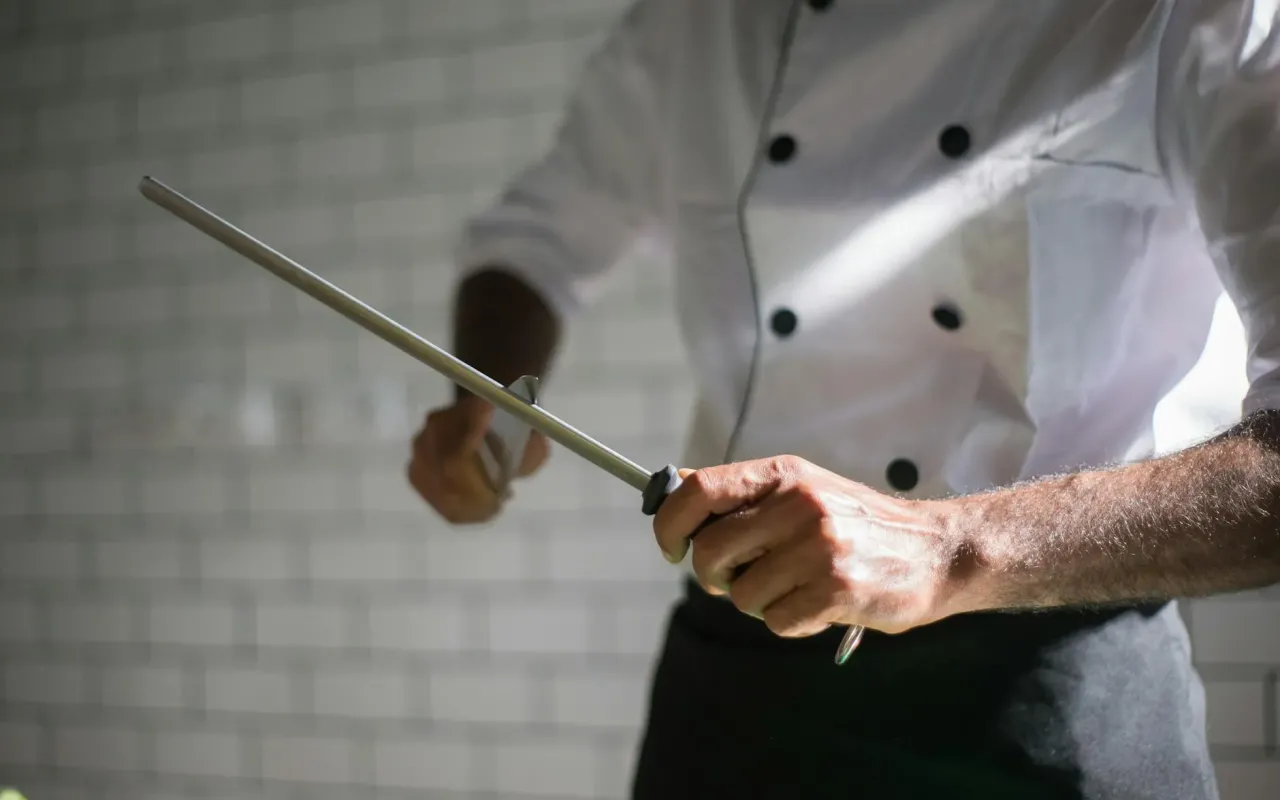
Use a honing rod—the steel rod that came with your knife set—for quick maintenance. Hold the rod vertically with the tip resting on a towel on your counter. Place the heel of the blade against the rod at a 15-20 degree angle, then draw the knife down and across the rod in a sweeping motion. Do 5 to 10 passes per side. You'll feel the edge realign as you go. It takes 30 seconds and makes a noticeable difference in cutting performance.
Pro tip: ceramic honing rods are gentler on hard Japanese steel than metal rods. If you own a Shun or Miyabi, invest in a ceramic rod for $25. For German steel, a standard metal rod works fine. And never use a honing rod on a serrated knife—it will ruin the serrations. Serrated knives need professional sharpening or a specialized tool.
How Often Should You Sharpen? A Realistic Schedule
If you cook dinner at home 4 to 5 nights a week, your chef's knife will need sharpening every 2 to 3 months. If you're a serious home cook who preps vegetables daily, bump that to every 6 to 8 weeks. The key indicator is performance: when you notice that you're pressing harder to cut onions or that the knife drags on tomato skin, it's time to sharpen.
Here's a simple schedule that works for me: hone every Sunday evening (takes 2 minutes), sharpen on the first weekend of every quarter. Mark it on your calendar. I use a recurring reminder on my phone. After 6 months of this routine, my knife still feels like it did the day I bought it. Most people's knives are dull because they wait until they're unusable, then try to fix everything at once. Consistent maintenance prevents that.
One caveat: if you cut on glass or stone cutting boards, your knife will dull 5 to 10 times faster than on wood or plastic. Switch to a bamboo or end-grain wooden board immediately. I've seen people sharpen their knives perfectly, then destroy the edge in one week on a glass board. Don't be that person.
Common Mistakes That Ruin Your Knife (And How to Avoid Them)
The biggest mistake is using too much pressure. People think they need to grind hard to remove metal, but that just creates uneven edges and heats up the blade. Use gentle, consistent pressure—think of it as petting a cat, not scrubbing a stain. If you're sweating, you're pushing too hard.
Another mistake is sharpening only one side. Most Western knives are double-beveled, meaning they need equal passes on both sides. If you only sharpen the right side, the edge will be asymmetrical and steer to the left when cutting. Count your passes and alternate consistently. I use a tally counter app on my phone to track—10 left, 10 right, repeat.
Finally, don't sharpen rusty or dirty knives. Clean the blade with soap and water first, then dry it completely. Rust particles will scratch the stone and embed in the edge, making it dull faster. If your knife has visible rust, use a rust eraser (available for $10 online) before sharpening. A clean knife and a clean stone are non-negotiable for good results.
When to Just Pay a Professional
If your knife has a chipped edge, a bent tip, or if you've never sharpened a knife before, consider paying a professional $5 to $10 for the first sharpening. Watch them do it. Ask questions. Then practice on an old beater knife before attempting your expensive Wüsthof. I ruined my first chef's knife by over-sharpening one side, and it took a professional to fix the geometry. Learn from my mistake.
Professional sharpeners also have access to belt grinders and diamond stones that can fix serious damage. For routine maintenance, however, a whetstone is all you need. The goal is to keep your knife in good shape between professional sessions, not to replace them entirely.
The 5-Minute Daily Routine That Keeps Your Knife Sharp
You don't need to sharpen every day, but you can maintain sharpness with a 5-minute routine. After each use, wash your knife by hand (never in the dishwasher—the heat and detergent dull the edge), dry it immediately, and store it in a magnetic strip or blade guard. A loose drawer is the fastest way to dull a knife.
Every other use, give your knife a quick hone on the rod. Every month, do a paper test to check sharpness. If it fails, do a quick 5-minute touch-up on the fine side of your stone. That's it. No complex schedules, no expensive equipment. Just consistent, simple care.
Your knife is the most-used tool in your kitchen. Treat it like one. A sharp knife makes cooking faster, safer, and more enjoyable. And honestly, once you feel that first perfect slice through a tomato without any pressure, you'll never go back to dull. Trust me—your fingers will thank you.