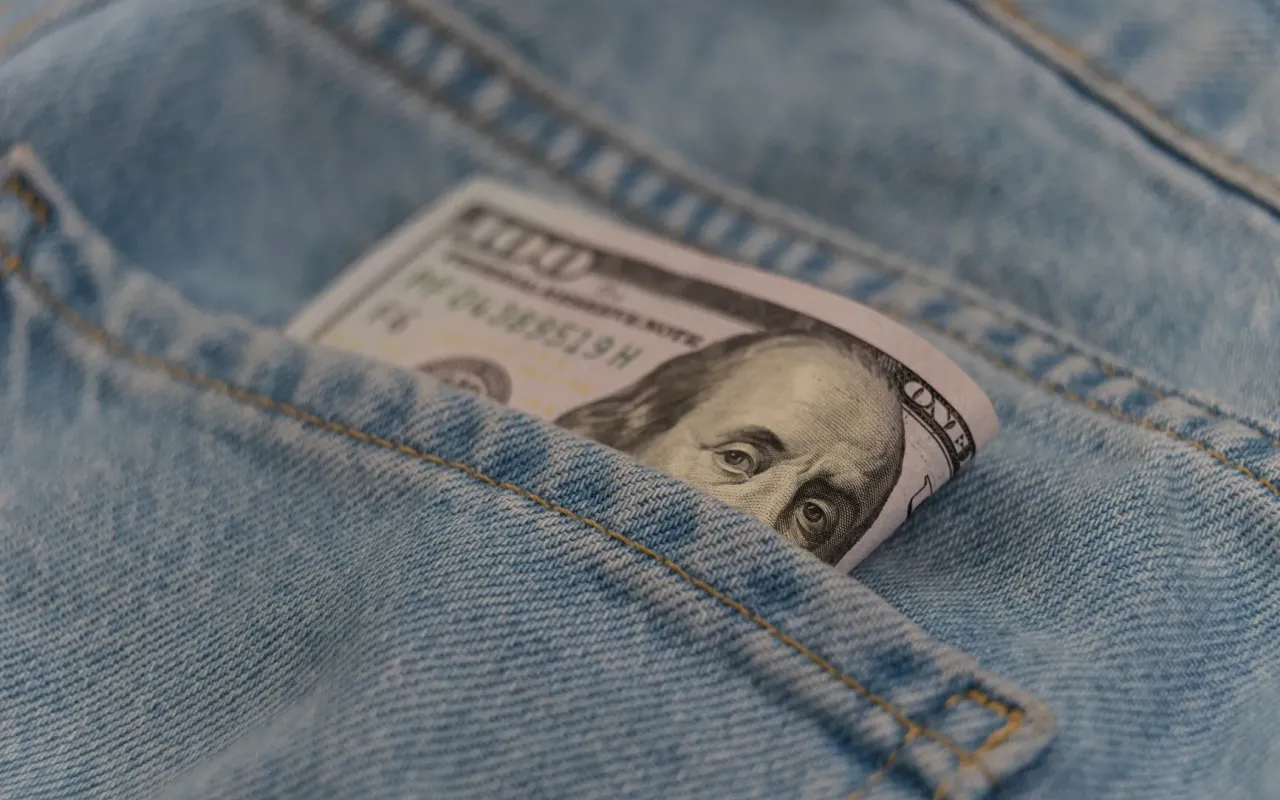
Stop waiting for a big windfall. Learn exactly how to start investing with just $100, including the best accounts, stocks, and strategies for real beginners.
- May 27, 2026
AceShowbiz - Let's be honest: when you hear "investing," your brain probably flashes to Wall Street traders, six-figure portfolios, or that friend who somehow turned a side hustle into a rental property. And then you look at your bank account—maybe you've got $100 left after rent, groceries, and that one streaming subscription you swear you'll cancel next month. It feels like the game isn't for you. But here's the surprising truth: with $100, you can actually start building real wealth. Not fantasy wealth. Real, compound-interest, slow-and-steady wealth. You just need to know where to put that money and what to expect when you do.
The biggest lie in personal finance is that you need thousands of dollars to invest. In reality, many brokerage apps let you open an account with zero minimum, and you can buy fractional shares of expensive stocks for as little as $1. So the barrier isn't cash—it's confusion. This article will cut through that confusion and give you a practical, no-BS plan to start investing with exactly $100. No jargon, no hype, just a clear path forward.
Why $100 Is Actually Enough to Start
I know what you're thinking: "$100 won't buy me a single share of Amazon or Google." And you're right—Amazon shares cost around $180 each. But you don't need a whole share anymore. Thanks to fractional share investing, you can buy $10 worth of Amazon stock, or $25 worth of Apple, or whatever fits your budget. This changes everything for the small investor.
More importantly, $100 is enough to start building a habit. Investing isn't about getting rich overnight—it's about consistency over time. A 2026 study by Fidelity found that investors who contributed small amounts regularly outperformed those who tried to time the market with lump sums. Starting with $100 teaches you the discipline of investing without the fear of losing a massive chunk of savings. You'll learn how markets move, how dividends work, and how your own emotions react to a dip—all with a relatively low stakes bet.
Here's the actionable takeaway: don't think of $100 as "too little." Think of it as your tuition into the world of investing. You'll learn more by actually owning $100 worth of a stock or ETF than by reading ten books about investing. The goal is to get in the game, not to win the game on day one.
Step One: Choose the Right Account Type
Before you buy anything, you need a place to hold your investments. This isn't like opening a regular checking account—there are specific account types designed for investing, and choosing the wrong one can cost you money in taxes or fees. For a beginner with $100, you have two main options: a taxable brokerage account or a retirement account like a Roth IRA.
Taxable Brokerage Account: The Flexible Starter
A standard brokerage account is the simplest option. You open it with an app like Robinhood, Fidelity, or Charles Schwab, deposit your $100, and start buying stocks or ETFs immediately. You can withdraw your money anytime without penalty, which is great if you're nervous about locking up cash. The downside? You'll pay taxes on any dividends or capital gains (profits) you earn.
For your first $100, I'd actually recommend a taxable account over a retirement account. Why? Because you're still learning. A Roth IRA has contribution limits and penalties for early withdrawal, which can feel restrictive when you're just testing the waters. With a taxable account, you can buy and sell freely, learn the mechanics, and then later, when you've built confidence and more savings, you can open a retirement account.
Roth IRA: The Long-Term Power Move
If you're already committed to not touching this money for decades, a Roth IRA is a tax powerhouse. You contribute after-tax dollars (so no deduction now), but all growth and withdrawals in retirement are completely tax-free. With $100, you can open a Roth IRA at Fidelity or Vanguard with no minimum. But be warned: you can't withdraw your earnings (only your contributions) before age 59½ without a penalty.
Practical tip: If you choose a Roth IRA, pick a target-date fund like Fidelity's Freedom Index 2060 Fund. It automatically adjusts your risk as you age, and you can buy into it with as little as $1. This is a "set it and forget it" move that works perfectly for a $100 starter investment.
Step Two: Decide What to Buy With That $100
Now comes the fun part—but also the part where most beginners sabotage themselves. They see a stock that tripled in a month and think, "I'll buy that and get rich fast." Resist that urge. With $100, you don't have the cushion to gamble on penny stocks or meme stocks. You need something boring, reliable, and diversified.
Option 1: A Low-Cost Index ETF (The Safe Bet)
An ETF (Exchange-Traded Fund) is a basket of stocks that tracks a market index, like the S&P 500. When you buy one share of an S&P 500 ETF, you're effectively buying tiny pieces of 500 of the largest U.S. companies—Apple, Microsoft, Nvidia, Johnson & Johnson, you name it. This gives you instant diversification, which is the single best way to reduce risk.
For $100, you can buy fractional shares of popular ETFs like VOO (Vanguard S&P 500 ETF) or IVV (iShares Core S&P 500 ETF). Historically, the S&P 500 has returned about 10% per year on average (before inflation). That means your $100 could grow to roughly $175 in 10 years, assuming you don't add another cent. Not life-changing, but remember: you're building a habit, not a fortune.
Option 2: A Single Blue-Chip Stock (The Learning Bet)
If you want a more hands-on experience, pick one well-established company you believe in. Think Coca-Cola, Procter & Gamble, or Microsoft. These are companies that have paid dividends for decades and are unlikely to go bankrupt tomorrow. Buying a single stock teaches you to follow company news, earnings reports, and market trends—skills that serve you well later.
But here's the catch: with only $100, you can't diversify enough. If that one company hits a rough patch (like Coca-Cola did in the 1990s), your entire investment takes a hit. So if you go this route, treat it as a learning experiment, not your core strategy. Plan to add more stocks as you save more money.
Option 3: A Robo-Advisor (The Autopilot Approach)
If you don't want to think about it at all, use a robo-advisor like Betterment or Wealthfront. You deposit your $100, answer a few questions about your risk tolerance and goals, and the algorithm builds and manages a diversified portfolio of ETFs for you. The fee is about 0.25% per year—that's $0.25 on your $100. Yes, it's cheap.
Robo-advisors are perfect for people who know they'll forget to log in or get emotional during market dips. They rebalance automatically and even offer tax-loss harvesting for larger accounts. For $100, you won't see massive gains, but you'll get a fully managed portfolio that mimics what a professional would build.
Step Three: Set Up a Recurring Deposit (Even $10 a Month)
Here's the secret that separates investors from people who just "dabble": consistency. A one-time $100 investment is a nice start, but it's not going to move the needle on your financial future. What will move the needle is adding to that position every month, even if it's just $10 or $20.
Let me show you the math. If you invest $100 once and never add another dollar, at 10% annual returns, you'll have about $1,745 after 30 years. That's not bad for a single $100 bill. But if you invest $100 initially and then add just $20 per month for 30 years, you'll have roughly $45,000. That's the difference between a nice dinner and a real down payment on a car—or even a house, depending on your market.
Most brokerage apps let you set up automatic transfers from your checking account. Schedule it for the day after payday, so the money is gone before you can spend it on takeout or coffee. Treat it like a bill you have to pay. Your future self will thank you.
Step Four: Understand the Real Returns You'll See
Let's get real about expectations. If you invest $100 in the stock market, don't expect to be checking your account every day for life-changing gains. In a good year, your $100 might grow to $110 or $115. In a bad year, it could drop to $85 or $90. That's normal, and it's why investing is a long-term game.
I want you to understand something called sequence of returns risk, but in reverse. For a beginner, the worst thing that can happen is the market goes up immediately. Why? Because you'll think you're a genius, you'll get overconfident, and you might gamble on riskier bets. The best thing that can happen is the market drops 20% in your first year. Then you'll learn to buy low, you'll feel the fear, and you'll realize you can survive it. Most millionaire investors made their first mistakes early, with small amounts of money.
Practical tip: Don't check your portfolio more than once a month. Set a calendar reminder for the first of every month to log in, see where you stand, and add your next deposit. The rest of the time, let the market do its thing. Your anxiety will drop, and your returns will actually improve because you're not panic-selling during dips.
Step Five: Avoid These Three Beginner Mistakes With $100
You're going to be tempted to do stupid things with your $100. I know because I did them myself. Here are the three biggest mistakes to avoid, and how to sidestep them.
Mistake 1: Chasing Hot Tips or Meme Stocks
Your coworker tells you about a "sure thing" crypto coin or a stock that's about to "moon." You FOMO in with your $100, and within a week, it's worth $40. This happens every single day. The truth is, if someone is telling you about a stock on social media or at the water cooler, the smart money has already bought and is selling to you. Stick to boring, established investments until you have at least $1,000 saved.
Mistake 2: Paying High Fees
Some brokers charge commissions per trade, and some mutual funds have expense ratios over 1%. With $100, a $5 trading fee eats 5% of your entire investment. That's insane. Use commission-free brokers like Fidelity, Schwab, or Robinhood. And always check the expense ratio of any ETF or mutual fund you buy. Aim for under 0.10%.
Mistake 3: Trying to Time the Market
You think, "I'll wait for the market to drop before I buy." The problem is, you won't know when the bottom is until it's passed. A 2021 study by Dalbar found that the average investor underperformed the S&P 500 by over 3% per year because they tried to time entries and exits. The best day to start was yesterday. The second best day is today. Just buy and hold.
What $100 Won't Do (And Why That's Okay)
Let's be brutally honest: $100 invested won't pay your rent, buy a car, or fund a vacation. It won't make you financially independent or turn you into a day trader. What it will do is teach you the mechanics of investing, build your confidence, and start the habit of putting money to work. Think of it as planting a seed, not expecting a forest tomorrow.
The real value of starting with $100 is psychological. Once you've done it, you realize that investing isn't scary or complicated. It's just a decision to allocate a small piece of your present income to your future self. And once you've made that decision once, it's much easier to make it again—with $200, then $500, then $1,000. The first step is always the hardest, and you've already taken it by reading this article.
So here's your action plan: by the end of this week, open a brokerage account (I recommend Fidelity or Schwab for beginners). Deposit $100. Buy $100 worth of VOO or IVV. Then set up a recurring $20 monthly deposit. Mark your calendar for one month from now to check your balance. That's it. No fancy strategies, no stock picks, no stress. Just the start of a journey that can change your financial life.