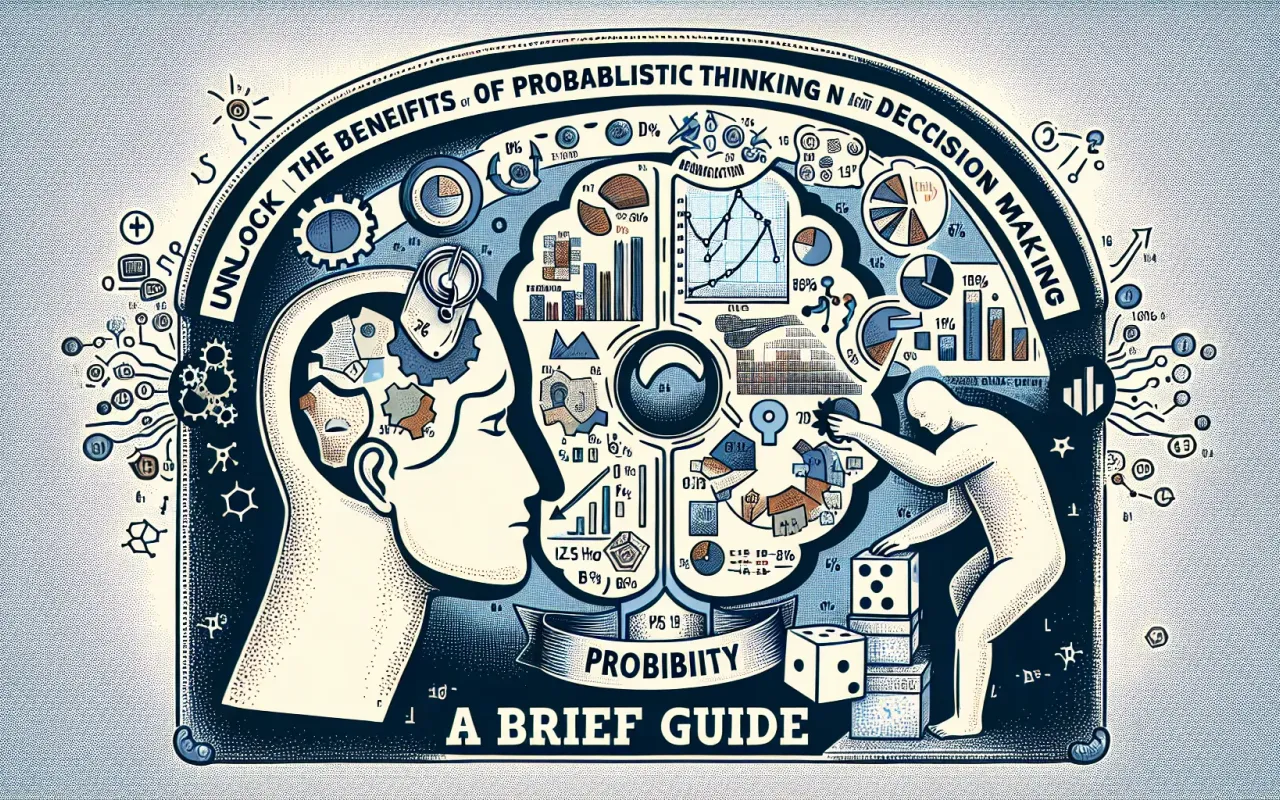
Discover how probabilistic thinking can enhance decision-making processes and lead to more informed and effective outcomes.
- August 24, 2024
In our fast-paced and data-driven world, the ability to make effective decisions is more crucial than ever. Probabilistic thinking, a method that leverages statistical reasoning, can significantly enhance decision-making processes. In this comprehensive guide, we’ll explore the benefits of probabilistic thinking in decision making, how it can be applied, and why it matters.
What is Probabilistic Thinking?
Probabilistic thinking involves understanding and utilizing the principles of probability to assess the likelihood of various outcomes. Instead of viewing decisions in binary terms of right or wrong, it allows individuals and organizations to weigh the potential risks and benefits by considering a range of possible scenarios and their probabilities.
Key Benefits of Probabilistic Thinking in Decision Making
1. Improved Risk Assessment
One of the primary benefits of probabilistic thinking in decision making is its ability to improve risk assessment. By evaluating the probabilities of different outcomes, decision-makers can better understand the risks involved and develop strategies to mitigate them. This approach is especially valuable in industries such as finance, healthcare, and engineering, where the stakes are high.
2. Enhanced Forecasting Abilities
Probabilistic thinking enhances forecasting abilities by allowing individuals to make more informed predictions about future events. Instead of relying on gut feelings or incomplete data, probabilistic models incorporate historical data and statistical analysis to generate more accurate forecasts. This can lead to better strategic planning and a competitive edge in the marketplace.
3. Balanced Decision Making
In decision making, emotions and biases often come into play. Probabilistic thinking provides a structured framework that helps balance emotional responses with objective data. By focusing on the probabilities of various outcomes, decision-makers can make more rational, balanced choices that are less influenced by personal biases.
4. Flexibility in Uncertain Situations
We live in an uncertain world, and traditional decision-making methods can sometimes fall short in such environments. Probabilistic thinking equips decision-makers with the tools to navigate uncertainty more effectively. By considering a range of possible outcomes and their associated probabilities, organizations can develop contingency plans and remain agile in the face of unpredictable circumstances.
5. Data-Driven Insights
Incorporating probabilistic thinking into decision-making processes promotes a culture of data-driven insights. This framework encourages the use of data and statistical analysis to inform decisions, leading to more reliable and actionable insights. Organizations that embrace this approach can better leverage their data assets to drive business success.
Applying Probabilistic Thinking in Decision Making
1. Identify the Possible Outcomes
The first step in applying probabilistic thinking is to identify the range of possible outcomes for a given decision. This may involve brainstorming potential scenarios, consulting with experts, or analyzing historical data to understand the various possibilities.
2. Estimate the Probabilities
Once the possible outcomes have been identified, the next step is to estimate the probabilities of each outcome occurring. This can be done using statistical models, historical data, or expert judgment. The goal is to assign a probability to each outcome based on the available evidence.
3. Evaluate the Implications
After estimating the probabilities, it’s important to evaluate the implications of each potential outcome. This involves considering the impact of each outcome on the organization and weighing the potential benefits and downsides. Decision-makers should also consider how different outcomes might interact or compound over time.
4. Develop a Strategy
With a clear understanding of the possible outcomes and their probabilities, decision-makers can develop a strategy that maximizes the chances of a favorable outcome. This might involve creating contingency plans, diversifying investments, or implementing risk mitigation measures.
5. Monitor and Adjust
Probabilistic thinking is not a one-time exercise. It requires ongoing monitoring and adjustment as new information becomes available. Decision-makers should continuously evaluate the accuracy of their probability estimates and adjust their strategies accordingly to remain adaptive and responsive to changes.
Real-World Examples of Probabilistic Thinking in Action
Finance
In the finance industry, probabilistic thinking is a fundamental tool for portfolio management, risk assessment, and trading strategies. Financial analysts use probabilistic models to assess market trends, evaluate investment risks, and optimize returns.
Healthcare
Healthcare professionals leverage probabilistic thinking to make critical decisions about patient care, treatment options, and medical research. By analyzing probabilities, doctors can recommend treatments with the highest likelihood of success and develop personalized care plans.
Engineering
In engineering, probabilistic methods are used to ensure the reliability and safety of complex systems. Engineers assess the probabilities of different failure modes, plan maintenance schedules, and design systems with built-in redundancies to prevent catastrophic failures.
Conclusion
Probabilistic thinking offers a powerful framework for making informed and balanced decisions in an uncertain world. By improving risk assessment, enhancing forecasting abilities, and promoting data-driven insights, it enables decision-makers to navigate complex environments more effectively. As organizations continue to embrace probabilistic thinking, they will be better equipped to make strategic choices that drive success and resilience.