The 'Harry Potter and the Half-Blood Prince' actress admitted she was a feminist and said feminism was not the same as 'man hating.'
- September 22, 2014
AceShowbiz -
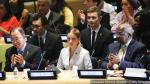
Emma Watson, who was recently appointed as a U.N. Women Goodwill Ambassador, gave a powerful speech at the headquarters of the United Nations to launch the HeForShe campaign against gender inequality on Saturday, September 20. Emma claimed being a feminist was not the same as "man-hating."
The "Harry Potter and the Order of the Phoenix" actress said, "I was appointed as Goodwill Ambassador for U.N. Women six months ago and the more I've spoken about feminism, the more I have realized that fighting for women's rights has too often become synonymous with man-hating. If there is one thing I know for certain, it is that this has to stop."
She continued, "For the record, feminism, by definition, is the belief that men and women should have equal rights and opportunities. It is the theory of the political, economic and social equality of the sexes. I started questioning gender-based assumptions a long time ago."
Emma talked about her journey to becoming a feminist. "When I was 8, I was confused about being called 'bossy' because I wanted to direct the plays that we would put on for our parents. But the boys were not," she shared, "When at 14, I started to be sexualized by certain elements of the media, when at 15, my girlfriends started dropping out of their beloved sports teams, because they didn't want to appear 'muscle-y,' when at 18, my males friends were unable to express their feelings, I decided that I was a feminist."
"And this seems uncomplicated to me. But my recent research has shown me that feminism has become an unpopular word," the "The Perks of Being a Wallflower" star continued, "Women are choosing not to identify as feminists. Apparently, I am among the ranks of women whose expressions are seen as too strong, 'too aggressive,' isolating and anti-men, unattractive, even. Why has the word become such an uncomfortable one?"
Emma claimed that gender inequality was also men's issue. "I've seen my father's role as a parent being valued less by society despite my need in his presence, as a child, as much as my mother's," she said, "I've seen young men suffering from mental illness, unable to ask for help, for fear it would make them less of a men-or less of a man... I've seen men made fragile and insecure by a distorted sense of what constitutes male success. "
She added, "Men don't have the benefits of equality, either. We don't want to talk about men being imprisoned by gender stereotypes but I can see that they are... It is time that we all see gender as a spectrum instead of two sets of opposing ideals. We should stop defining each other by what we are not and start defining ourselves by who we are. We can all be freer and this is what HeForShe is about. It's about freedom."