Skip the baggage claim and the fees. Here's how to pack for a week or more in one personal item bag, with real tips that actually work.
- November 15, 2026
AceShowbiz - You know that moment at the gate when the agent announces the flight is full and asks for volunteers to check their carry-ons? Everyone with a rolling suitcase groans. You just keep walking to your seat with your bag still on your shoulder. That's the quiet superpower of traveling with only a personal item.
Personal item travel isn't about deprivation. It's about moving through airports faster, never paying a bag fee, and never standing at a carousel wondering if your luggage made the connection. Airlines have made this skill more valuable than ever. Budget carriers like Frontier and Spirit now charge for a full-size carry-on, and even mainline carriers have tightened their sizer boxes. A personal item that fits under the seat in front of you is the last free luggage you have left.
Here's how to actually pull it off, whether you're gone for a weekend or two weeks.
Start With the Right Bag, Not the Right Packing List
Most people fail at personal item travel before they pack a single thing. They grab a duffel that's technically the right dimensions but has no structure, or a backpack with so many pockets that half the usable volume disappears into dividers. The bag matters more than any packing trick.
Airlines generally define a personal item as something around 18 x 14 x 8 inches, though the exact numbers vary. Spirit's limit is 18 x 14 x 8. Frontier's is 18 x 14 x 8. United and Delta don't publish a hard number but expect it to fit under the seat. Measure your bag yourself with a tape measure, because manufacturers round up and sizers don't.
Look for a bag with a clamshell opening, so you can see everything at once instead of digging through a top-loading sack. A soft-sided backpack with compression straps beats a hard case because you can squish it into a tight sizer and into an overhead bin on a regional jet. Ideally, it also has a luggage pass-through sleeve so it slides onto a rolling bag if you ever travel with one.
What to skip
- Bags with rigid frames or wheels — they waste volume and rarely fit sizers
- Anything with more than three exterior pockets
- Bags that don't have a laptop sleeve against your back, which doubles as structure
Actionable tip: Before you buy, check whether the bag's listed dimensions include the pockets and straps. A bag that measures 18 inches empty can bulge to 20 once it's full, and that's the version the gate agent sees.
Pack for Laundry, Not for the Whole Trip
The single biggest mindset shift is this: you are not packing for the number of days you'll be gone. You're packing for the number of days between laundry sessions. That's usually three to four. Once you accept that, a week-long trip and a two-week trip require almost the same bag.
Plan on roughly three tops, two bottoms, one layer, and four to five days of underwear and socks. If you're staying somewhere with a sink, you can hand-wash a shirt and a pair of socks each night and hang them to dry. A travel-sized bottle of laundry detergent sheets or a bar of castile soap weighs almost nothing and takes up less space than a pair of jeans.
Choose a color palette so everything matches everything. If every top works with every bottom, you get far more outfits out of five pieces than you'd expect. Think navy, gray, black, and one accent color. This isn't a fashion rule, it's a math trick. Three tops and two bottoms in a matching palette give you six combinations; three tops and two bottoms in clashing colors give you maybe two.
Actionable tip: Do a test pack a week before your trip, then live out of that bag for two days at home. You'll immediately discover the thing you forgot and the three things you don't actually need.
Wear Your Bulkiest Items on Travel Day
Your outfit on the plane is free luggage space. That's not a hack, it's just physics. Wear your heaviest shoes, your bulkiest jacket, and your thickest pair of pants. A pair of boots on your feet saves more space than any packing cube will ever give you.
This matters most in cold weather, where a single coat can eat half a personal item. If you're flying somewhere chilly, wear the coat and pack a thin packable down layer for extra warmth. Layers on your body are far more efficient than layers in your bag.
Be careful about overdoing it, though. If you're wearing four layers through security, you'll be the person holding up the line while you unlace boots and peel off a sweater. Wear the bulky items, but keep the security process simple. Slip-on shoes you can wear on the plane are worth their weight even if they're not your warmest option.
Actionable tip: Pack a lightweight stuff sack or tote in an exterior pocket. If you get warm at the airport, you can shed a layer and stuff it into the tote rather than carrying it in your arms.
Use Compression and Cubes Strategically
Packing cubes and compression bags are not gimmicks, but they're also not magic. Used well, they can add 20 to 30 percent more usable space. Used badly, they add bulk and weight and make your bag harder to close.
Roll your clothes rather than folding them flat. Rolling compresses fabric and reduces wrinkles, and it lets you see everything at a glance. For bulky items like fleece or a sweater, use a compression cube with a double zipper — you'll be surprised how flat a midlayer can get. Don't bother with vacuum bags for a personal item; the plastic is heavy and they rarely reseal well on the road.
Pack the heaviest items closest to your back, which keeps the bag balanced and stops it from pulling on your shoulders. Put soft items around the edges and in the bottom, where they act as cushioning for anything fragile. Leave a small amount of empty space at the top, because bags that are packed to the zipper seams are the ones that don't fit the sizer.
A quick packing order that works
- Shoes at the bottom, stuffed with socks or chargers
- Compression cube of clothes in the middle
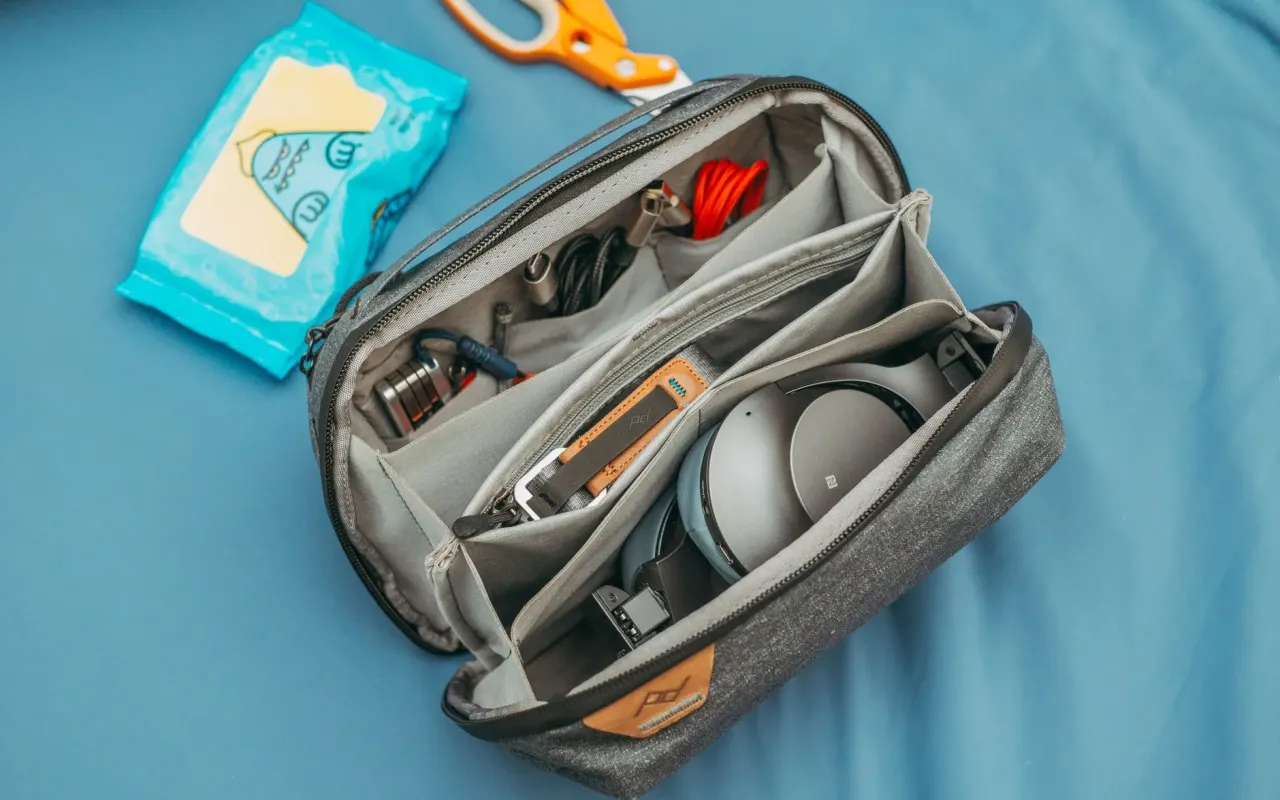
- Toiletries in a clear quart bag, flat against one side
- Laptop and electronics sleeve against your back
- Snacks, charger, and a thin layer in the top pocket for easy access
Actionable tip: Weigh your packed bag on a kitchen scale before you leave. Personal items usually aren't weighed, but knowing the number keeps you honest and helps you decide what to cut.
Downsize Your Toiletries and Tech
Toiletries are where personal item travel quietly falls apart. A full bottle of shampoo, a hairdryer, and a bag of makeup can take up a third of your space. The fix is to buy solid versions of the things you use most and to rely on the hotel or your destination for the rest.
Solid shampoo bars, solid conditioner, and a bar of soap take up almost no space and pass through security without a second look. A travel toothbrush and a small tube of toothpaste are enough for a week. If you need a razor, a disposable one weighs almost nothing. Skip the hairdryer entirely — nearly every hotel and Airbnb has one, and if it doesn't, you can live without it for a few days.
On the tech side, the biggest space hog is usually a laptop. If you can get away with a tablet and a keyboard case, do it. Bring one charger and one cable that can charge everything, plus a small power bank. A single universal adapter beats a bag of region-specific plugs. Headphones, a phone, and a compact e-reader round out a kit that fits in a side pocket.
Actionable tip: Pack toiletries in a clear quart-size bag and keep it at the top of your bag. You'll sail through security and you'll never have to dig for your liquids again.
Plan for the Return Trip and the Real World
Every personal item traveler eventually faces the same problem: the trip home. Souvenirs, gifts, and a few extra shirts can turn a perfectly packed bag into something that won't zip. Plan for it before you leave.
Leave about 15 percent of your bag empty on the way out. Bring a foldable tote or a packable daypack that lives in an exterior pocket, so you have a place for anything you buy. If you're visiting a city with good thrift stores or markets, buy a shirt there instead of packing one. And if you truly can't fit everything, mailing a small box home is often cheaper than paying a checked bag fee.
Think about the weather and the activities you'll actually do. A personal item traveler who packs for a hypothetical dinner party ends up carrying clothes they never wear. Pack for the trip you've planned, not the trip you might take. If you're going to a wedding, wear the outfit on the plane and pack only the accessories.
Finally, accept that personal item travel is a skill you get better at. Your first trip will feel tight. Your third will feel normal. By the fifth, you'll wonder why you ever checked a bag.
Actionable tip: Before you book, check the personal item size for your specific airline and route. Regional jets and budget carriers have the tightest limits, and a bag that works on one airline may not fit another.