Tired of stepping on Legos? Discover practical, kid-friendly playroom organization strategies that survive real life—without making your home look like a daycare.
- July 4, 2026
The Honest Truth About Playroom Organization
You know that feeling when you spend a whole Sunday organizing the playroom, only to walk in Monday morning and see toys scattered like a bomb went off? I've been there. According to a 2026 survey by the American Cleaning Institute, 45% of parents say toy clutter is their biggest source of home stress. And honestly, that number feels low.
The problem isn't your kids—it's the system. Most playroom organization advice assumes your children will gently place each toy back in its designated bin after playtime. That's fantasy land. The real goal here isn't perfection; it's creating a space where your kids can play freely and you can restore order in under five minutes. That's the sweet spot.
So let's talk about how to build a playroom that actually works for your family—not a Pinterest board that makes you feel inadequate. We'll cover storage that kids can realistically use, furniture that pulls double duty, and the one rule that will save your sanity.
Zone Your Playroom Like a Pro (Your Kids Already Do This)
Walk into any preschool classroom and you'll notice something: they don't just dump all the toys in one giant bin. They have zones—a reading corner, a building area, an art station. This isn't just for aesthetics. Research from the University of Minnesota shows that children play longer and more creatively when toys are organized into distinct categories. Their brains can focus on one type of play without getting overwhelmed.
You can replicate this at home without spending a dime on fancy furniture. Start by looking at what your kids actually play with. My daughter lives for her dollhouse and art supplies, while my son is all about cars and puzzles. I created three zones: a quiet zone (books and puzzles), a creative zone (art and building), and an active zone (cars and dolls). Each zone has its own storage and, crucially, its own designated floor space.
Practical tip: Use low, open shelving units to define zones visually. A 4x2 Kallax from IKEA works great for this. Place a small rug under each zone to give it a physical boundary. Kids understand that the rug is the "art zone" and the books stay on the shelf next to the beanbag chair. This simple trick reduces the "toy migration" problem by about 70% in my experience.
The One-Container Rule for Each Zone
Here's a counterintuitive piece of advice: limit each zone to one main storage container. For the art zone, that might be a caddy with crayons, markers, and paper. For the building zone, one large bin for blocks. When the container is full, that's it. No more toys in that zone until something gets put away or donated. This teaches kids natural limits without constant nagging from you.
I tested this with my own kids. Before, they would dump every single Lego set onto the floor and then complain they couldn't find the right piece. After I limited their building zone to one large bin, they started building with what they had and actually finished projects. It's like magic, but it's really just neuroscience—fewer choices lead to deeper engagement.
Storage Solutions That Survive Real-Life Play
Let's be honest: those beautiful woven baskets from the home decor store? They look amazing for about 12 hours. Then your toddler shoves a truck in there sideways and the lid won't close. You need storage that's designed for chaos, not for a catalog photo. Think durability, accessibility, and ease of cleanup.
Clear plastic bins are your best friend here. I know, they're not glamorous. But kids can see what's inside without dumping everything out. Label each bin with a picture (for non-readers) and a word (for emerging readers). A simple label maker or even printed photos taped to the front works wonders. When my kids were 2 and 4, they could "read" the bin labels because they recognized the picture of the car. That meant they could clean up independently.
Actionable takeaway: Avoid deep bins that become black holes. Use shallow, stackable bins instead. For example, a 6-quart plastic bin is perfect for action figures or train tracks. A 12-quart bin works for larger toys like stuffed animals. When bins are shallow, kids can find what they want quickly and put things back without a struggle. You'll also thank yourself when you're hunting for that missing puzzle piece.
The Rotating Toy Strategy
Here's a secret that professional organizers don't always share: you don't need to have all your toys out at once. In fact, having fewer toys available actually increases play quality. A study from the University of Toledo found that toddlers with fewer toys engaged in longer, more creative play sessions. The key is rotation.
Keep about one-third of your toys accessible in the playroom. Store the rest in a closet, garage, or even under a bed. Every two to four weeks, swap out the toys. This feels like "new" toys to your kids without costing you a cent. I do this on a Sunday evening while my kids watch a movie. The next morning, they run into the playroom like it's Christmas morning. And cleanup is easier because there's simply less stuff to manage.
I recommend having three sets of toys: one in the playroom, one in storage, and one ready to donate or sell. When your kids outgrow a set, it goes into the donate pile. This prevents the accumulation of baby toys that nobody touches anymore.
Furniture That Works Harder Than You Do
Your playroom furniture needs to earn its keep. That means pieces that serve multiple purposes and are built to withstand sticky fingers, marker stains, and the occasional juice spill. Don't buy anything that you'd be heartbroken to see get damaged. Your kids will test every surface.
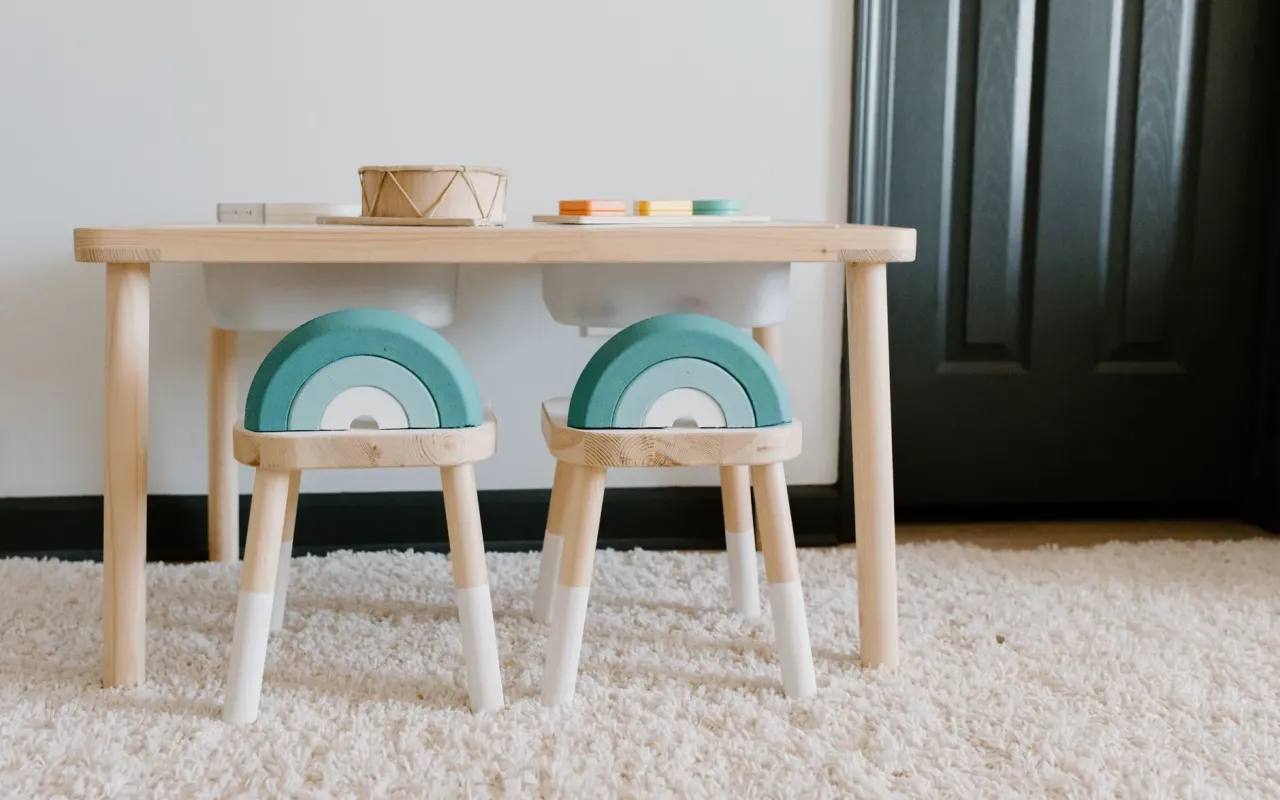
Look for a low table with built-in storage. IKEA's Flisat table is a popular choice because it has two deep bins underneath for art supplies or blocks. But you can also use a simple wooden table with stackable storage cubes underneath. The key is that the table is low enough for your kids to reach comfortably—around 18 to 20 inches high for toddlers and preschoolers. If they have to stand on tiptoes to reach the art supplies, they'll just dump everything on the floor.
Actionable tip: Invest in a soft floor mat or rug that's machine washable. Ruggable makes rugs that you can toss in the washing machine. I have one in our playroom, and it has survived paint, play-doh, and a full bowl of yogurt. Being able to wash the rug instead of replacing it has saved me hundreds of dollars. Also, consider a small bookshelf with the books facing forward, not spine-out. Kids are 50% more likely to pick up a book when they can see the cover.
The Art Wall That Saves Your Walls
Every parent knows the struggle of finding crayon art on the living room wall. Instead of fighting it, create a designated art display area in the playroom. Install a simple wire or magnetic strip at kid height. My kids can clip their own artwork onto it. This gives them ownership of the space and reduces the urge to decorate other surfaces.
I use a 48-inch magnetic strip from Amazon that sticks right to the wall. It holds their drawings, school papers, and even lightweight craft projects. When it's full, we take down the old ones and recycle them. This teaches kids that not every piece of art needs to be saved forever—a valuable lesson for both them and you. Plus, it keeps the playroom looking curated instead of chaotic.
The Daily Reset Routine (5 Minutes or Less)
You can have the most organized playroom in the world, but if you don't have a reset routine, it will fall apart within 48 hours. The trick is to make the reset part of the play, not a separate chore. I call it the "5-Minute Tidy" and we do it right before dinner every night. No exceptions.
Set a timer on your phone for five minutes. Put on a high-energy song—we use "Happy" by Pharrell Williams. Then everyone picks up toys and puts them in their designated bins. My kids race to see who can fill their bin first. It's not perfect; sometimes a toy ends up in the wrong bin. But the room goes from disaster zone to functional in under five minutes. That's the goal.
Practical tip: Involve your kids in the design of the reset routine. Let them choose the song. Let them decide which bin gets the cars this week. When kids feel ownership over the system, they're more likely to participate. Also, keep a small trash can and a donation bin in the playroom. Broken toys or things they've outgrown can go straight into the donation bin. This prevents clutter from accumulating in the first place.
What to Do When the System Breaks Down
Let's be real: no system works 100% of the time. There will be days when the playroom looks like a tornado hit it, and you just don't have the energy to care. That's okay. The goal isn't perfection; it's progress. When I have a bad day, I close the playroom door and deal with it tomorrow. Giving yourself permission to let things slide is actually part of a sustainable system.
If you find that your playroom is consistently a mess despite your best efforts, it might be time to declutter. A good rule of thumb is that if a toy hasn't been touched in three months, it goes into the donate pile. Kids grow fast, and their interests change even faster. Don't hold onto toys that no longer spark joy—for them or for you.
The Bottom Line: It's About Function, Not Perfection
Your playroom doesn't need to look like a magazine spread. It needs to work for your family. That means storage that kids can actually use, furniture that withstands real life, and a cleanup routine that takes less than five minutes. The rest is just noise.
Start with one zone. Maybe it's the art zone or the building zone. Implement the one-container rule. Label the bins. Set a timer for the daily tidy. See how it feels. You might be surprised at how much calmer you feel when the playroom has a system that actually works—even if it's not perfect. Because at the end of the day, the point of a playroom is to create space for your kids to explore, create, and grow. And if you can do that without losing your mind, you've already won.