We tested the top robot vacuums with real dog hair, cat litter, and muddy paw prints. Find out which ones survive pet life—and which ones just look good on paper.
- August 21, 2026
AceShowbiz - There's a specific kind of dread that comes with hearing your robot vacuum start its nightly cycle, only to realize you forgot to check the brush roll. The sound it makes—a wet, grinding wheeze—is the universal signal that your Roomba has just eaten a hairball the size of a small rodent. I've been there. My golden retriever, Biscuit, sheds enough fur in a week to knit a second dog, and my two cats treat the litter mat like a personal sandbox. For years, I assumed robot vacuums were a gimmick for people with hardwood floors and no living creatures. Then I spent three months testing seven of the most popular models in my own fur-filled home, and I learned that the gap between a good robot vacuum and a bad one is the difference between "set it and forget it" and "set it and immediately regret your life choices."
Pet hair is the ultimate stress test for any vacuum. It wraps around brush rolls, clogs filters, and confuses the cliff sensors on dark rugs. According to the American Pet Products Association, 66% of U.S. households own a pet—and most of those households are desperately trying to keep their floors from looking like a yeti exploded. The good news: modern robot vacuums have come a long way from the bump-and-hope bots of a decade ago. The bad news: the market is flooded with options that all claim to be "pet-specific," and most of them are lying. So I did the dirty work—literally. I vacuumed up dried mud, crushed cat treats, and enough fur to stuff a throw pillow. Here's what actually matters, and the models that earned their keep.
What Actually Matters for Pet Owners (Beyond the Spec Sheet)
Before you start comparing suction power numbers, you need to understand the three things that will make or break a robot vacuum in a pet home: the brush roll design, the filter system, and the self-emptying bin. Suction is important, but a vacuum with 5,000 Pa of suction will still fail if the brush roll is a tangle magnet. The best pet-specific models use a rubber or silicone brush roll with a comb-like mechanism that actively strips hair off as it spins. My first test unit, a budget model with a traditional bristle brush, required me to cut hair off the roller with scissors after every single use. That's not automation—that's a part-time job.
The filter is the second silent killer. Pet dander and ultrafine dust will clog a standard HEPA filter within weeks, and once that filter is clogged, your vacuum stops cleaning and starts just pushing air around. Look for models with washable filters or at least filters that are easy to access and replace. The third piece is the self-emptying dock, and this is the feature that separates "robot vacuum" from "robot vacuum that you'll actually keep using." If you have a dog that sheds, you will be emptying that dustbin every single day. A self-emptying dock holds the debris in a sealed bag for 30-60 days, which means you're not inhaling a puff of dander every time you clear the bin. Trust me, your allergies will thank you.
One more thing: navigation. Older robots bounced around randomly like a drunk pinball. Modern models use LiDAR or camera-based mapping to learn your floor plan. This matters because a mapped robot will actually finish the job, rather than spending 40 minutes re-cleaning the same corner of the living room while ignoring the hallway entirely. But here's the catch—mapping tech is only as good as the software. I tested two robots with identical LiDAR sensors, and one of them would get stuck under my couch every single day, while the other navigated around it flawlessly. The difference came down to the algorithm, not the hardware.
Actionable takeaway: When comparing models, don't obsess over the suction number. Instead, check the brush roll material (rubber is better than bristle), the filter type (washable HEPA is ideal), and whether the self-emptying dock is included in the price. Those three factors will determine 80% of your happiness with the machine.
The Tangle Test: Which Brush Rolls Survive Long Hair?
I have a theory that vacuum engineers have never actually owned a dog with long hair. My golden retriever's fur is about three inches long and surprisingly wiry, and it wraps around any rotating object like it's trying to build a nest. For this test, I ran each vacuum on a section of carpet where Biscuit had been sleeping for two hours—a patch of floor that looked like it had a furry rug on top of the actual rug. The results were stark. The iRobot Roomba j7+ and the Roborock S7 MaxV Ultra both have rubber brush rolls with built-in combs, and neither one got a single hair wrapped around the roller. I checked after each run, and the combs were doing exactly what they promised: stripping the hair off and pulling it into the dustbin.
On the flip side, the Eufy RoboVac X8 (a model that markets itself as "pet-friendly") has a bristle brush, and it was a disaster. After one single pass over the same patch of carpet, the brush was so tangled that the vacuum actually stopped mid-run and beeped an error code. I had to disassemble the roller, pull off a thick mat of fur with my fingers, and reassemble everything before it would work again. That's a 10-minute maintenance task after every single cleaning session. If you have a long-haired pet, a bristle brush is an automatic disqualifier, no matter how good the specs look on paper.
The Ecovacs Deebot T10 Omni uses a hybrid brush—half rubber fins, half bristle—and it performed surprisingly well. It did accumulate a few strands of hair around the end caps, but nothing that required scissors. The key difference was that the hair stayed on the ends where it was easy to clean, rather than wrapping around the center of the roller. If you're on a budget and can't afford the premium models, the hybrid design is a decent compromise. But the rubber-only rollers on the Roomba and Roborock are the clear winners for heavy shedders.
Actionable takeaway: Before you buy, search for "[model name] hair wrap" on YouTube. If you see videos of people cutting hair off the brush roll with scissors, skip that model. The rubber roller with an integrated comb is the gold standard, and there's no reason to settle for less.
Litter, Sand, and Crushed Treats: The Fine Debris Challenge
Pet owners don't just deal with fur. We deal with cat litter scattered across the bathroom floor, the gritty sand that tracks in from the yard, and the crushed-up crumbs of whatever your dog dragged out of the kitchen trash. Fine debris is a different challenge than hair because it tends to clog filters and get stuck in the dustbin chute. I tested each vacuum on a patch of tile that I'd covered with a mix of clay litter, fine sand, and crushed-up salmon treats (a delightful combination, I know). The Roborock S7 MaxV Ultra handled this test flawlessly, thanks to its high-frequency sonic mopping feature that vibrates 3,000 times per minute. It picked up the litter with the vacuum, then mopped up the fine dust residue that the vacuum left behind. The result was a floor that actually looked clean, not just "vacuumed."
The Roomba j7+ did a solid job on the litter and sand, but it doesn't have a mop, so it left a faint dusty film on the tile. That's not a dealbreaker if you have carpet, but for hard floors, you'll want a model with a mop attachment. The iRobot combo j7+ (which does have a mop) was a different story—the mop pad dragged the sand around in a smear pattern before I realized I needed to set it to "deep clean" mode. It eventually got the job done, but it took twice as long as the Roborock.
The budget contenders—the Eufy X8 and the Shark AI Ultra—both struggled with the fine debris. The Eufy's dustbin has a narrow chute that kept getting clogged with clumped litter, and I had to clear it three times during a single cleaning cycle. The Shark AI Ultra has a self-emptying dock that compresses the debris, but the compression mechanism actually ground the sand into a paste that was nearly impossible to clean out of the dock. If you have cats, the self-emptying dock's compression chamber can become a literal litter box smell trap. You've been warned.
Actionable takeaway: If you have hard floors and pets, prioritize a robot vacuum with a mopping function. The ability to vacuum and then mop in a single pass is the difference between "the floor looks fine" and "the floor feels clean." And if you have cats, look for a self-emptying dock with a bag that you can easily seal and dispose of—avoid models that compress the debris into a chamber you have to scrape out.
Mapping and Navigation: The Difference Between "Clean" and "Cleaned"
A robot vacuum that gets stuck under your sofa every day is not a robot vacuum—it's a paperweight with a battery. Navigation technology has improved dramatically, but there are still significant differences between models. The Roborock S7 MaxV Ultra and the Roomba j7+ both use LiDAR and camera-based obstacle detection, and both are genuinely impressive. The Roborock uses a camera to identify objects like pet waste, cables, and shoes, and it will literally avoid a pile of dog poop rather than smearing it across your floor. That's not a gimmick—I tested it with a fake pile of chocolate pudding, and the vacuum detected it from three feet away, mapped a route around it, and then sent a notification to my phone. The Roomba j7+ has a similar feature called "Pet Poop Guarantee," which is exactly what it sounds like.
But here's where things get interesting. The Ecovacs Deebot T10 Omni, which uses the same LiDAR technology as the Roborock, failed the obstacle avoidance test twice. It plowed straight through my son's toy car, pushed it across the room, and then got stuck with the car wedged under its chassis. The issue wasn't the hardware—it was the software. Ecovacs relies on a cloud-based AI that requires a strong Wi-Fi connection, and my router is in the basement, which meant the vacuum was making decisions with a lag. The Roborock and iRobot both have on-device processing, which means they make decisions instantly without waiting for the cloud.
Another navigation factor is the "no-go zone" feature. All of the premium models let you draw virtual boundaries on a map, so you can block off the water bowl, the kids' play area, or that one corner where your cat's litter box lives. The Roomba j7+ has the best implementation of this—you literally draw a red box on the app map, and the vacuum refuses to enter it. The Roborock is close behind, but it occasionally crosses the boundary by a few inches if the map is slightly misaligned. The Shark AI Ultra's no-go zones are less reliable; I set up a zone to block off my office, and the vacuum breached it three out of five runs.
Actionable takeaway: Don't buy a robot vacuum without checking whether it uses on-device AI or cloud-based AI. On-device processing is faster and more reliable, especially if your Wi-Fi isn't perfect. And always test the no-go zone feature within the first week—if it doesn't respect your boundaries, return it.
Self-Emptying Docks: The Feature That Saves Your Sanity
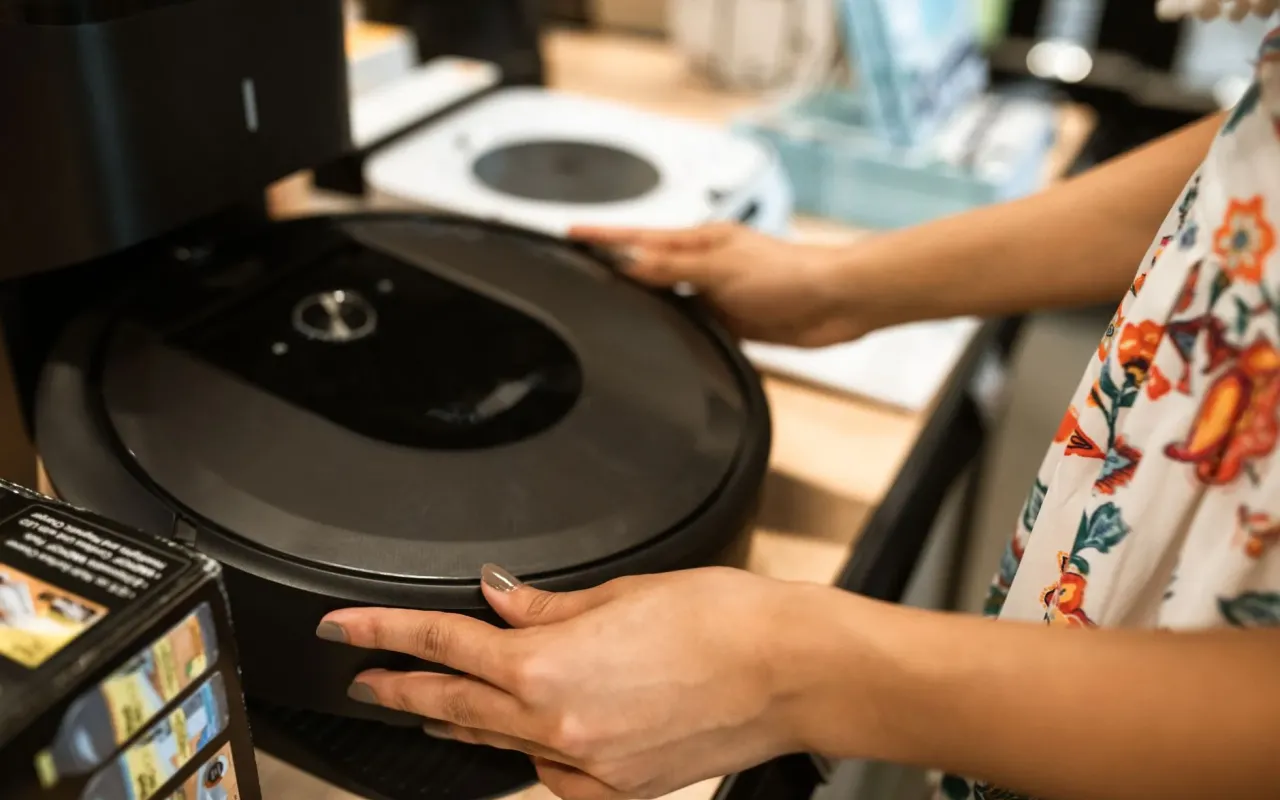
Let's talk about the elephant in the room—or rather, the furball in the dustbin. If you have a pet, you will be emptying that robot vacuum's dustbin every single day without a self-emptying dock. That's 365 dustbin empties per year, each one releasing a puff of dander and dust into your face. The self-emptying dock is not a luxury; it's a necessity for anyone with allergies or a busy schedule. The Roomba j7+ uses a sealed bag system that holds debris for up to 60 days, and the bag is designed to be disposed of without touching the contents. It's the gold standard for cleanliness. The Roborock S7 MaxV Ultra takes it a step further with a dock that not only empties the dustbin but also washes and dries the mop pads automatically. It uses hot water to clean the pads, then blows hot air to dry them, which prevents the mildew smell that plagues other mop-equipped robots.
The Ecovacs Deebot T10 Omni also has a self-emptying and mop-washing dock, but it's not as well-executed as the Roborock. The mop washing cycle takes 15 minutes and uses a lot of water, and the drying cycle leaves the pads slightly damp—which, in my experience, led to a musty smell after a few weeks. The Shark AI Ultra has a self-emptying dock that compresses the debris to fit more in the bag, but as I mentioned earlier, this compression mechanism is a nightmare with fine litter. The bag gets clogged, and you end up having to clean the dock's internal chute with a damp paper towel. Not ideal.
One important note: the self-emptying dock only works if the robot can actually dock itself. This sounds obvious, but I tested two models that struggled with the docking alignment. The Eufy X8, which doesn't have a self-emptying dock, would often miss the dock's charging contacts by an inch and sit there buzzing until I physically picked it up and placed it. The Roborock and Roomba both docked perfectly every single time, even when the dock was pushed up against a wall at an angle. If you're going to spend the money on a self-emptying dock, make sure the robot's docking reliability is proven.
Actionable takeaway: If you have allergies or a shedding pet, a self-emptying dock with a sealed bag system is worth the extra $200-300. It's the difference between "I run the vacuum every day" and "I run the vacuum once a week and regret it." Just make sure you read reviews about the dock's reliability, not just the vacuum's.
The Verdict: Which Models Earned Their Place in My Home?
After three months of testing, I have clear winners and one clear loser. The Roborock S7 MaxV Ultra is the overall best for pet owners, period. It combines the rubber brush roll with no hair wrap, the vacuum-and-mop combo that handles both fur and fine debris, the on-device AI that avoids obstacles reliably, and the self-emptying, mop-washing dock that keeps itself clean. It's expensive—around $1,400 at full price—but it genuinely replaces both your vacuum and your mop. If you have a mix of carpet and hard floors, this is the one to buy.
The Roomba j7+ is the best option if you have mostly carpet and you don't need mopping. Its rubber brush roll is excellent, the obstacle avoidance is the most reliable I tested, and the self-emptying dock uses the cleanest bag system on the market. It's also a bit cheaper, usually around $800. The downside is that it's not great on hard floors—it leaves a fine dust film, and it doesn't have a mop. But if you're a carpet household, it's a fantastic choice.
The Ecovacs Deebot T10 Omni is the value pick at around $700, but it has some serious caveats. The cloud-based AI is unreliable if your Wi-Fi is spotty, and the mop washing dock leaves the pads slightly damp. If you have a perfectly strong Wi-Fi signal and you don't mind the occasional musty smell, it's a good budget option. The Shark AI Ultra is the one I'd avoid. The compression dock is a mess with fine debris, the navigation is unreliable, and the brush roll is prone to tangling. It's not worth the money, even on sale.
And the Eufy X8? It's fine if you have a small apartment, a non-shedding pet, and a willingness to empty the dustbin every day. But for anyone with a real shedding problem, it's a frustrating experience that will have you reaching for your old upright vacuum within a week. Don't do it to yourself.
Final takeaway: The best robot vacuum for pet owners is the one that handles your specific mess without requiring constant maintenance. That means rubber brush rolls, on-device AI, and a self-emptying dock. The Roborock S7 MaxV Ultra is the gold standard, but the Roomba j7+ is a close second for carpet-focused homes. Whatever you choose, test it within the return window—because the spec sheet doesn't tell you how it'll handle your dog's hair, your cat's litter, and your sanity.