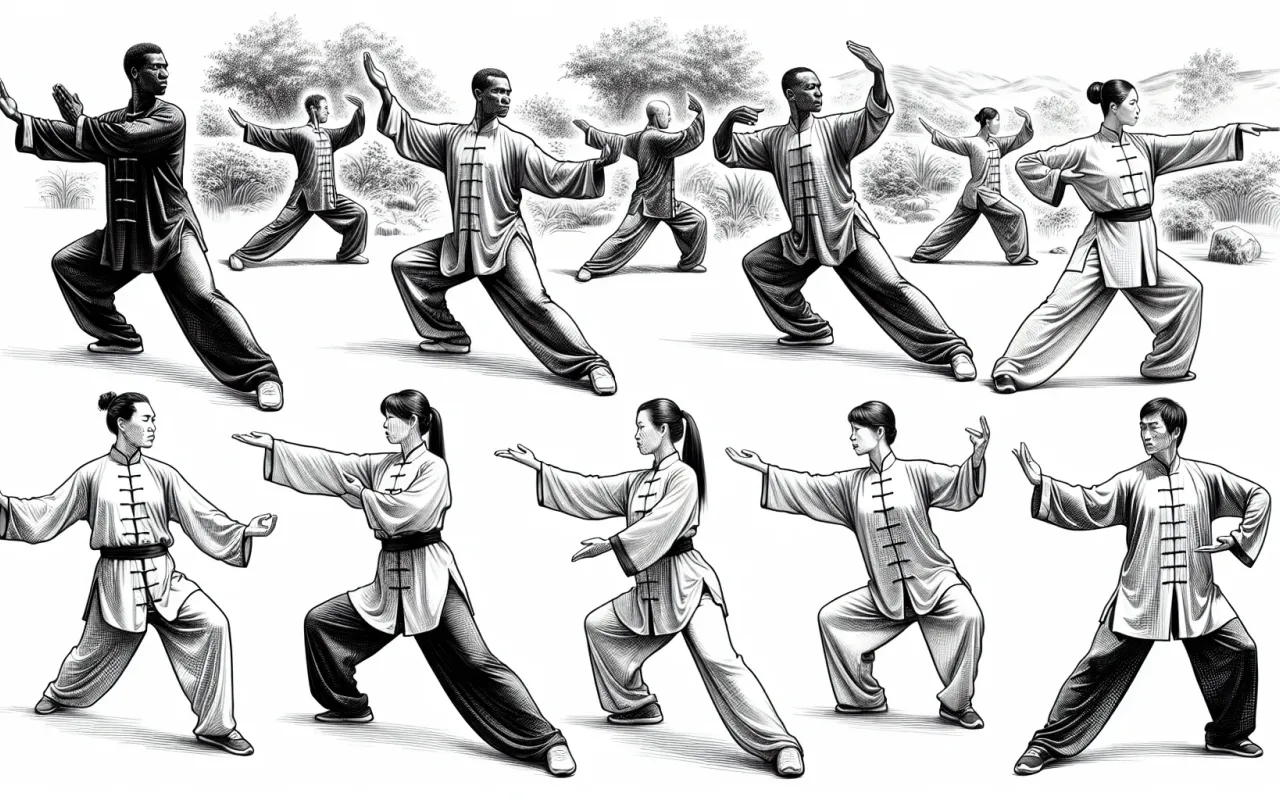
A comprehensive step-by-step guide to mastering Tai Chi Form 24. Learn the 24 steps in Tai Chi forms with detailed descriptions and tips for each movement.
- August 12, 2024
Tai Chi, also known as Tai Chi Chuan, is a traditional Chinese martial art that combines slow, deliberate movements, meditative breathing, and a focus on mental clarity. One of the most popular sequences in Tai Chi is the Form 24, also known as the Beijing 24 Form. This article provides a detailed step-by-step guide to mastering the 24 steps in Tai Chi forms for both beginners and seasoned practitioners.
Introduction to Tai Chi Form 24
The Tai Chi Form 24 is a standardized set of movements developed to make Tai Chi more accessible to the general public. It consists of 24 steps that are engineered to promote relaxation, balance, and internal strength. This form remains deeply rooted in traditional Tai Chi principles while also being simplified for ease of learning and practice.
Planning Your Practice
Before diving into the specific movements, it is essential to set the right environment for practice. Wear loose, comfortable clothing and choose a quiet, spacious area where you can move freely. Aim to practice regularly, even if for short periods, to develop consistency and improve your skills over time.
Step-by-Step Guide to Tai Chi Form 24
1. Commencing Form (Qi Shi)
The first step sets the tone for your practice. Stand with feet shoulder-width apart, arms relaxed at your sides. Slowly raise your arms to shoulder height with palms facing down, and then slowly lower them. Focus on your breathing and center your mind.
2. Parting the Wild Horse's Mane (Ye Ma Fen Zong)
Begin with your feet together. Step out to your left, shifting your weight to your left leg. As you step out, sweep your right arm forward and your left arm back, mimicking a horse's mane. Repeat on the opposite side.
3. White Crane Spreads Its Wings (Bai He Liang Chi)
Shift your weight to your left leg, raising your right knee and arm upward while your left arm lowers downward. Imagine a crane gracefully spreading its wings.
4. Brush Knee and Twist Step (Lou Xi Ao Bu)
From the previous posture, step forward with your right foot while brushing your left hand past your knee and your right hand forward as if pushing away an invisible opponent. Alternate sides to complete the step.
5. Playing the Lute (Shou Hui Pipa)
Step back slightly with your right foot and bring your right hand up towards your shoulder while your left hand remains near your hip. This position resembles holding a traditional Chinese lute.
6. Repulse Monkey (Dao Nian Hou)
Step backward while alternately swinging your arms back and forth. Focus on maintaining balance and fluid motion as you "repulse the monkey."
7. Grasp the Bird's Tail (Lan Que Wei)
This sequence is broken into four parts: ward off, roll back, press, and push. Each movement should flow into the next seamlessly.
8. Single Whip (Dan Bian)
Shift to the left while extending your right arm and shaping your fingers into a whip-like position. This step is essential for cultivating fluidity and precision.
9. Wave Hands Like Clouds (Yun Shou)
Step side-to-side while moving your arms in a circular, cloud-like motion. Imagine your hands are gentle clouds drifting through the sky.
10. Single Whip (Dan Bian)
Repeat the single whip movement, focusing on maintaining continuity and balance.
11. High Pat on Horse (Gao Tan Ma)
Shift into a forward stance while patting your hands forward as if patting a horse. This step emphasizes coordination and strength.
12. Kick with Right Heel (You Deng Jiao)
Transition your weight to your left leg and kick forward with your right heel. Maintain balance and control throughout the kick.
13. Strike Ears with Both Fists (Shuang Feng Gu Er)
Pull both fists to your waist and thrust them forward simultaneously as if striking an opponent's ears.
14. Turn and Kick with Left Heel (Zhuan Shen Deng Jiao)
Pivot on your right foot and kick forward with your left heel. Focus on a smooth, controlled turn.
15. Snake Creeps Down (She She Xia Shi)
Drop your weight into a low stance while lowering your arms in a snake-like motion. This step requires flexibility and control.
16. Golden Rooster Stands on One Leg (Jin Ji Du Li)
Shift your weight to one leg and raise the opposite knee, balancing with both arms extended. Repeat on the other leg.
17. Fair Lady Works at Shuttles (Yu Nu Chuan Suo)
This sequence consists of a series of flowing movements resembling weaving. Focus on smooth, coordinated shifts.
18. Needle at Sea Bottom (Hai Di Zhen)
Step forward and extend one hand down as if reaching for a needle at the bottom of the sea, while the other hand extends backward.
19. Fan Through Back (Shan Tong Bei)
Shift into a forward stance and sweep one arm in a wide arc as if fanning it through your back. Focus on broad, graceful movements.
20. Turn, Deflect, Parry, and Punch (Zhuan Shen Ban Lan Chui)
Pivotal on your back foot while simultaneously deflecting, parrying, and punching forward in one smooth movement.
21. Apparent Close-Up (Ru Feng Si Bi)
Bring your hands together in front of your chest and then extend outward as if closing an imaginary door.
22. Cross Hands (Shi Zi Shou)
Stand with feet together and cross your hands in front of your chest, signifying the nearing end of the form.
23. Closing Form (He Shi)
Slowly lower your arms and bring your feet together, standing tall and relaxed. This step signifies the conclusion of the form.
24. Return to Upright Position (Shi Zong)
Briefly stand still with hands by your sides, taking a moment to absorb the practice and focus on your breathing before you move away.
Conclusion
Mastering the Tai Chi Form 24 steps is not only about learning a sequence of movements but also about embracing the philosophy and benefits of Tai Chi. Regular practice of these 24 steps in Tai Chi forms can lead to improved mental clarity, physical balance, and overall well-being. Remember, the journey of mastering Tai Chi is continuous and should be approached with patience and mindfulness.