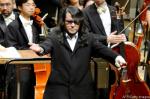
A ghostwriter named Takashi Niigaki accuses Samuragochi of not being deaf in addition to revealing that the star didn't compose his own music.
- February 7, 2014
AceShowbiz -
Mamoru Samuragochi, who's been lauded as "Japanese Beethoven", rose to fame in the mid-1990s after he claimed that he composed hit symphonies despite being deaf. Now, Samuragochi has been exposed as a fraud after the ghostwriter whom he's been working with for nearly two decades revealed that the star didn't compose his own music.
According to Japanese media, a man named Takashi Niigaki issued a statement on Wednesday, February 5 in which he claimed to be the real composer of Samuragochi's hits. He said he'd worked for the 50-year-old musician for 18 years and got fed up when he decided to end their partnership last year.
Niigaki, who's a lecturer at Toho Gakuen School of Music in Tokyo, had been paid about 7 million yen (about $69,999) to write more than 20 pieces for Samuragochi. He additionally doubted the composer's hearing impairment, saying, "I saw no signs that he could not hear."
Samuragochi's lawyers, Kazushi Orimoto and Mizuki Wakamatsu, have responded to Niigaki's admission. "Samuragochi is deeply sorry as he has betrayed fans and disappointed others," they said in a statement. "He knows he could not possibly make any excuse for what he has done." However, they insisted that Samuragochi is indeed deaf.
"I started hiring the person to compose music for me around 1996, when I was asked to make movie music for the first time," Samuragochi added, as cited by NHK. "I had to ask the person to help me for more than half the work because the ear condition got worse."
According to his official biography, Sumuragochi was born in Hiroshima to survivors of the 1945 atomic bomb attack and began playing music and composing at an early age. He completely lost his ability to hear at age 35.
His best work is "Symphony No. 1 (Hiroshima)", which was dedicated to the victims of the 1945 atomic bomb in his home city. He also contributed music to popular video games "Resident Evil: Dual Shock" and "Onimusha".