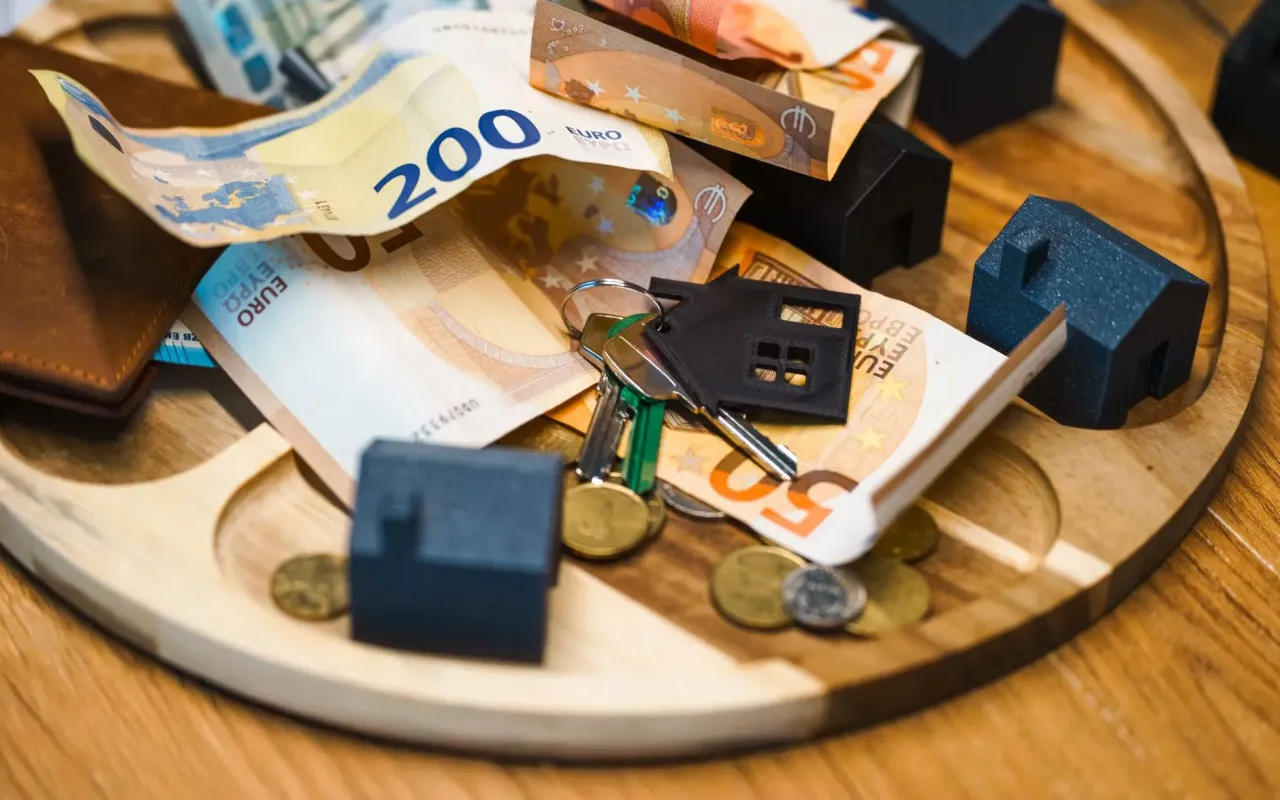
Think you need a fortune to start investing in property? Here are five creative, low-cash strategies that actually work for regular people.
- June 17, 2026
AceShowbiz - My friend Sarah thought she was priced out of real estate forever. She made a decent salary as a marketing manager, but after rent, student loans, and groceries, her savings account barely scraped $8,000. Every article she read talked about needing 20 percent down—which for a $300,000 house meant $60,000. She felt like the party had started without her.
Then she bought her first rental property with $5,000 out of pocket. No, it wasn't a fixer-upper in a war zone. It was a two-bedroom condo in a decent suburb, and she did it using a strategy most people have never heard of. The truth is, real estate investing isn't reserved for the wealthy or the lucky. It's available to anyone willing to think sideways about money and leverage other people's resources. Here's how you can do it too, even if your bank account looks more like a piggy bank than a war chest.
Why the 20 Percent Down Myth Keeps You Stuck
The biggest lie in real estate investing is that you need 20 percent down to buy a property. That rule applies to conventional loans when you're buying a primary residence and want to avoid private mortgage insurance. But investors have options that completely bypass this requirement.
FHA loans, for example, allow you to put down as little as 3.5 percent. The catch is that you need to live in the property for at least one year. That's not a barrier—it's a strategy. You buy a duplex, triplex, or fourplex, live in one unit, and rent out the others. Your tenants effectively pay your mortgage while you build equity. After a year, you can move out and repeat the process.
Sarah used an FHA loan to buy her first property. She found a duplex listed for $180,000. Her down payment was $6,300—just 3.5 percent. The rent from the other unit covered $950 of her $1,200 monthly mortgage payment. Her out-of-pocket cost to live there was $250 a month, less than what she'd been paying for a one-bedroom apartment. Within two years, she had saved enough to buy another property using the same method.
Practical tip: Call three local mortgage lenders and ask specifically about FHA loans for multi-unit properties. Don't ask about investment loans—ask about owner-occupied loans for 2-4 unit buildings. The rates are lower, and the down payment is smaller.
House Hacking: The Fastest Path to Your First Property
House hacking is the single most accessible strategy for anyone with little money. The concept is simple: you buy a property, live in part of it, and rent out the rest to cover your costs. It's not a loophole or a hack in the scam sense—it's a legitimate way to use your primary residence as an income-producing asset.
The most common version is buying a multi-unit building. But you can also house hack a single-family home by renting out bedrooms on a month-to-month basis, or by buying a home with a basement apartment or an accessory dwelling unit. Some investors even buy a house with a large lot and park an RV or tiny home in the backyard for a tenant.
Consider the math on a typical scenario. You buy a $250,000 triplex with 3.5 percent down—that's $8,750. The three units rent for $900, $950, and $1,000 respectively. Your total monthly mortgage payment, including taxes and insurance, is $1,800. If you live in the $900 unit, your tenants pay $1,950 in rent, which covers your mortgage and puts $150 in your pocket. You're living for free while someone else builds your wealth.
Practical tip: Use websites like Redfin or Zillow to search for 2-4 unit properties in your area. Sort by price per square foot to find undervalued buildings. Then run the numbers: total rent from all units minus your mortgage payment. If the number is positive or close to zero, you've found a candidate.
Partnering with Money: How to Use Other People's Cash
You don't need your own money if you can find someone else's. Real estate investing is a team sport, and the most successful investors are masters at raising capital from friends, family, or even strangers. The key is to structure the deal so everyone wins.
One common structure is the equity split. You find the deal, manage the property, and handle all the headaches. Your partner provides the down payment and closing costs. You split the profits 50/50 when you sell, or you share the monthly cash flow. The partner gets a return on their money without doing any work. You get a property without putting up any cash.
Another option is the private money loan. You borrow money from an individual—often a family member or a trusted friend—at a fixed interest rate, say 8 to 10 percent. You use that money for the down payment and closing costs. You then make monthly payments to your lender just like a bank, but with much more flexible terms. When you refinance or sell, you pay back the principal.
I know an investor named James who started with zero dollars. He found a motivated seller who wanted to sell a $150,000 house quickly. James asked his uncle for a $20,000 loan at 9 percent interest. He used that money for the down payment on a conventional loan. The house needed $10,000 in repairs, which he financed by getting a credit card with a 0 percent introductory APR. He fixed the place up in three months, rented it out, and used the rental income to pay his uncle and the credit card. Within two years, he had paid off the loan and owned the property free and clear.
Practical tip: Write down a list of five people you know who have money sitting in savings accounts earning 0.5 percent interest. Approach them with a specific deal: "I need $25,000 to buy a property. I'll pay you 8 percent interest, paid monthly, and I'll pay back the principal in three years. Here's the property, the numbers, and my plan." Most people will say no, but one might say yes.
Seller Financing: When the Seller Becomes Your Bank
Seller financing is a strategy where the person selling the property acts as the bank. Instead of you getting a mortgage from a traditional lender, the seller agrees to accept payments directly from you over time. This can eliminate the need for a large down payment entirely.
Here's how it works in practice. You find a seller who owns a property free and clear—no existing mortgage. You agree on a purchase price of $200,000. Instead of the seller demanding cash at closing, they agree to finance $190,000 of that amount. You put down $10,000 and make monthly payments to the seller at an agreed interest rate, typically 5 to 7 percent. The seller gets a steady income stream, and you get a property with minimal cash outlay.
Sellers are often motivated by tax advantages. When they sell a property for cash, they may owe significant capital gains taxes. By financing the sale themselves, they can spread the tax liability over many years. Some sellers also prefer the steady income over a lump sum, especially if they're retired or approaching retirement.
To find seller financing deals, you need to look for motivated sellers. Look for properties that have been on the market for more than 60 days. Look for owners who are moving out of state, going through a divorce, or dealing with an inherited property they don't want. These sellers are more likely to consider creative terms because they want to close the deal quickly.
Practical tip: When you make an offer on a property, include a note that says, "I'm interested in owner financing terms. Would you consider carrying a note for a portion of the purchase price?" Most real estate agents won't ask this for you, so you need to communicate directly with the seller or have your agent include it in the offer.
The BRRRR Method: Buy, Rehab, Rent, Refinance, Repeat
The BRRRR method is a powerful strategy for investors who have a little cash and a lot of hustle. The idea is to buy a distressed property below market value, fix it up, rent it out, then refinance based on the new, higher value. You pull your original cash out during the refinance, leaving you with a cash-flowing property and your initial investment back in your pocket.
Let's walk through a real example. You find a three-bedroom house listed for $100,000. It needs $30,000 in repairs. You negotiate the price down to $85,000. You put $15,000 down using a conventional loan or a hard money loan. You spend $30,000 fixing it up, using cash from savings or a contractor who allows payment plans. After the rehab, the house is worth $160,000. You rent it out for $1,500 a month.
Now you refinance. The bank appraises the house at $160,000. They offer you a loan for 75 percent of that value—$120,000. You use that $120,000 to pay off your original purchase loan and your rehab costs. You now have a property worth $160,000, a mortgage of $120,000, and you've pulled out your original $15,000 down payment plus your $30,000 rehab costs. You're back to zero cash invested, but you own a rental property that cash flows $300 a month.
The BRRRR method requires discipline and a good team. You need a reliable contractor who can estimate rehab costs accurately. You need a real estate agent who understands the strategy and can help you find deals below market value. And you need a lender who is comfortable with the refinance step. But if you execute it correctly, you can build a portfolio of properties with the same $15,000 over and over again.
Practical tip: Before you attempt a BRRRR, practice on a smaller scale. Find a property that needs cosmetic repairs only—paint, flooring, landscaping. Do the work yourself or hire a handyman. Rent it out. Then refinance. The learning curve is steep, but the payoff is enormous.
What Nobody Tells You About Starting Small
Every successful real estate investor started with less than you think. They didn't have a trust fund or a six-figure salary. They had a willingness to learn, a tolerance for risk, and a strategy that worked with their actual financial situation. The biggest mistake beginners make is waiting until they have "enough" money to start. That day never comes.
The truth is, you will make mistakes. You will buy a property that needs more repairs than you expected. You will get a tenant who pays late. You will have a month where the water heater breaks and the roof leaks simultaneously. But those experiences teach you more than any book or podcast ever could. And each mistake makes you a better investor.
Start with one strategy. Pick house hacking, seller financing, or partnering with money. Focus on that single approach until you've done it successfully. Don't try to learn everything at once. Real estate is a marathon, not a sprint. The people who succeed are the ones who take the first step, even when that step feels terrifying and their bank account feels empty.
Sarah now owns four rental properties. She started with $5,000 and a duplex. She didn't have a perfect plan. She just had the courage to try. You have that same courage. Your bank account doesn't define your potential—your willingness to start does.